Bioprocess Symposium «Passion for Bioprocessing» · 3 November 2026, Bern · free of charge Register ➜
pH control
Typically 5–7 for yeast and 6–7.5 for bacteria; controlled via acid/base addition.
Bioprocess Symposium «Passion for Bioprocessing» · 3 November 2026, Bern · free of charge Register ➜
Bioprocess Symposium «Passion for Bioprocessing» · 3 November 2026, Bern · free of charge Register ➜

Microbial cells (bacteria, yeast) enable small scale microbial fermentation with rapid growth rates (doubling times of 20–60 min), achieve very high cell densities (>100 g/L dry cell weight), and tolerate higher shear than mammalian cells, but generate significant metabolic heat and oxygen demand. Their metabolism often leads to rapid pH shifts, foam formation, and accumulation of by-products such as acetate (bacteria) or ethanol (yeast), requiring Applikon bioreactors for precise aeration, mixing, and feeding strategies.
Prokaryotic bacteria lack organelles and post-translational modifications, enabling simple media and high yields of recombinant proteins, enzymes, or biofuels. Yeasts offer eukaryotic folding but slower growth. These properties require robust bioreactors like Applikon MiniBio, autoclavable glass, single-use or stainless steel bioreactors. Applikon bioreactors enable optimum gas transfer (high kLa), precise temperature control, and flexible feeding for batch, fed-batch, or continuous fermentation.
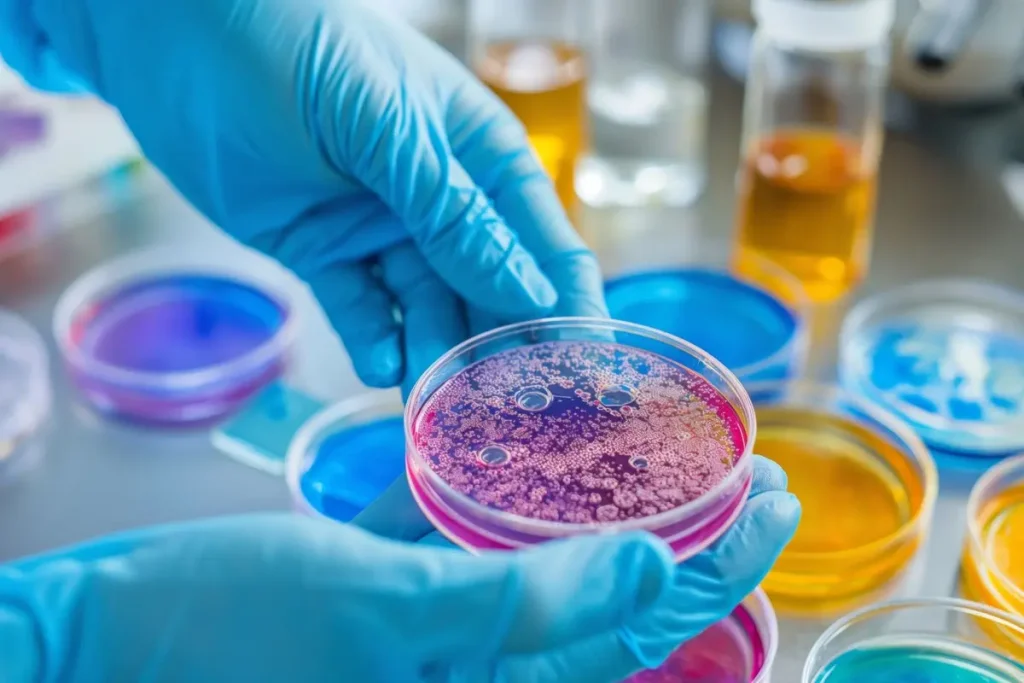
Microbial fermentations rely on tight control of a few core parameters across all bioreactor types (Mini Bio, lab scale glass, single-use or stainless steel).
Typically 5–7 for yeast and 6–7.5 for bacteria; controlled via acid/base addition.
High oxygen transfer rates (OTR) with air or air/O₂ mixtures; kLa is key for scale-up.
From mesophilic (30–37°C) to thermophilic; fast metabolic heat removal.
Higher impeller speeds for mass transfer, suitable for shear-tolerant strains.
Carbon/nitrogen feeds to avoid overflow metabolism and by-products.
A typical microbial fermentation follows a simple, reproducible sequence adaptable to batch, fed-batch, or continuous operation.
Shake flask or small seed bioreactor for healthy inoculum.
Transfer to the Applikon production bioreactor at defined cell concentration.
Control pH, DO, temperature, antifoam; optional feeds
Biomass, product, substrates via off-/at-line analytics.
Broth collection for downstream; BioSep enables continuous harvest at high densities (brief note: typically downstream equipment).
Microbial fermentation works across all Applikon formats with tailored mixing, aeration, and controls.
| Type | Scale | Key Use Cases | Microbial-Specific Features |
|---|---|---|---|
| Applikon MiniBio glass small-scale bioreactor | 0.25–1 L | Strain screening, media optimization | High kLa/OTR in low volume, antifoam integration, Peltier cooling and heating |
| Applikon glass autoclavable bioreactors for microbial fermentation | 2–20 L | Process development, scale-down models | Multiple spargers, high agitation for O₂ demand, jacketed or single wall vessel |
| AppliFlex ST single‑use bioreactor for microbial fermentation | 0.5–15 L | Development & small production | Robust mixing, foam control, no cross-contamination, cooling option available |
| Stainless-steel bioreactors for large-scale microbial fermentation and continuous perfusion | from 20L to 5000L | Pilot & large-scale production | Consistent H/D design for optimum scale-up, high gas flow, heat exchange, CIP / SIP for fast cycles |
Intensify microbial fermentation for maximum productivity in Applikon bioreactors. These transfer consistently from Applikon Mini bioreactor to production scale.
Controlled feeds for high cell densities without by-products.
O₂ enrichment, advanced spargers for peak demand.
Optimized for expression systems (e.g., phase-specific induction).
In the field of industrial microbiology, bioreactor fermentation stands as a cornerstone technique for producing a broad spectrum of microbial products — from antibiotics and biofuels to food and beverages. The Applikon bioreactor portfolio is at the forefront of this domain, offering precision and control for cultivating bacteria, yeast, and fungi.
The Applikon Mini bioreactor combines precision control with flexibility, allowing researchers and industrial biotechnologists to fine-tune environmental parameters to meet the specific needs of various microbial strains. It generates precise and valuable data on extremely small bench space, providing the foundation for large-scale production.
The microbial fermentation process in the Applikon bioreactor follows a carefully orchestrated sequence, from preparation through to monitoring — each step optimized for maximum yield and reproducibility.
The bioreactor is prepared and assembled, sensors are calibrated and the unit is sterilized via autoclaving. This ensures a completely sterile environment and guarantees that all system components in contact with the culture are free of unwanted contaminants. The integrity and purity of the microbial culture provides the basis for successful fermentation outcomes.
A carefully prepared microbial seed culture is introduced into the bioreactor. The Applikon bioreactor design ensures optimal mixing time for uniform inoculation into the culture medium. Precision at this stage is crucial for establishing an initial cell population that exploits the full capacity of the bioreactor for consistent fermentation.
The bioreactor accurately controls temperature (customizable for different microbial strains), pH (continuous monitoring with automatic adjustment), dissolved oxygen (finely tuned for aerobic or anaerobic needs), and agitation (dual Rushton impellers ensuring homogeneous mixing, effective gas exchange, and preventing cell sedimentation).
Versatile nutrient feeding strategies — batch, fed-batch, and continuous modes — allow precise control over nutrient supply. Automated feeding systems adjust nutrient delivery based on real-time measurements of biomass concentration and metabolic activity, maximizing product yields while minimizing undesirable by-products.
Cutting-edge sensors provide real-time monitoring of critical parameters such as pH, oxygen levels, and temperature. Continuous surveillance enables timely adjustments, ensuring the culture develops under optimal conditions until the desired cell density or product concentration is achieved.

Our specialists support you throughout the entire bioprocess lifecycle — from system selection and application design to implementation, optimization, and long-term operation. We work closely with you to ensure reliable, compliant, and scalable solutions tailored to your requirements.
Reach out to discuss innovative approaches for your project.
The right choice depends on your scale and application. The Applikon MiniBio (0.25–1 L) is ideal for strain screening and media optimisation at small scale — offering high kLa and integrated antifoam control. Autoclavable glass bioreactors (2–20 L) are well suited for process development and scale-down models. The AppliFlex ST (0.5–15 L) is a single-use system that eliminates cross-contamination risks, making it a practical choice for development and smaller production runs. For pilot and large-scale production, stainless steel bioreactors from 20 L to 5,000 L are available — with CIP/SIP for fast turnaround between batches. Resea Biotec is happy to help you select the right system for your process.
Microbial cultures — particularly bacteria and yeast — grow rapidly and generate significant metabolic heat alongside high oxygen demand. Applikon bioreactors are designed specifically for these conditions: optimised gas transfer with high kLa values, aeration using air or air/O₂ mixtures, and agitation systems engineered for efficient mass transfer. Temperature is controlled precisely via heating/cooling jackets or Peltier elements at smaller scales. This keeps pH shifts, foam formation, and by-product accumulation — such as acetate in bacteria or ethanol in yeast — reliably under control throughout the fermentation.
Yes — this is one of the core strengths of the Applikon platform. A consistent height-to-diameter (H/D) design across all bioreactor sizes ensures that mixing behaviour, gas transfer, and control characteristics remain comparable as you scale up. Process parameters developed in the MiniBio at 50 mL working volume can be reliably transferred to stainless steel bioreactors of up to 5,000 L — without the need for extensive re-optimisation. This saves development time, reduces costs, and gives you confidence that the results achieved at research scale will be reproducible in full production.
Applikon bioreactors at Resea Biotec support the production of a broad range of microbial products — including recombinant proteins and enzymes for pharmaceutical and industrial applications, biotherapeutics such as vaccines and antibody fragments, antibiotics and secondary metabolites, biofuels and bio-based chemicals, as well as food ingredients and beverage components. Both prokaryotic bacteria such as E. coli and eukaryotic yeasts like Saccharomyces cerevisiae or Pichia pastoris are routinely cultivated in Applikon glass and stainless steel bioreactors — from the MiniBio through to 5,000 L production systems.
In fast-growing microorganisms such as E. coli, uncontrolled glucose supply can trigger overflow metabolism — recognised by acetate accumulation in bacteria or ethanol formation in yeast — which impairs cell growth, product yield, and process stability. Applikon bioreactors address this through precise fed-batch strategies with controlled carbon and nitrogen feeding, coupled with real-time monitoring of biomass, substrates, and metabolites. The Livit Flex control system enables automated feed regulation that keeps metabolism within the optimal zone — supporting cell densities above 100 g/L dry cell weight without compromising product quality. Explore our bundle solutions for complete fermentation workflows.


