Bioprocess Symposium «Passion for Bioprocessing» · 3 November 2026, Bern · free of charge Register ➜

A bioreactor is a vessel where living cells or microorganisms grow under closely controlled conditions to make a product. The difference from a simple culture vessel: temperature, pH, dissolved oxygen and mixing are not just measured, they are actively controlled.
An overview of controlled bioreactor types
The term bioreactor covers several different designs. They differ primarily in how mixing is achieved and how oxygen is transferred into the liquid. In a wave bioreactor, a rocking platform generates the movement — very gentle, but with limited oxygen transfer. In bubble columns and airlift reactors, rising gas bubbles do both jobs at once. Fixed-bed and hollow-fibre systems work well for adherent cells at high cell density.
The stirred-tank reactor is the most common type of reactor and the focus of this article. It is the only type that allows mixing, aeration, temperature and pH to be controlled independently of one another and can be scaled up to volumes of several thousand litres. This makes it the clearest example for illustrating the principle of the control loop. The basic logic — measure, compare, act — is the same for every design.
Cultivation conditions
What the culture really needs
For cells to grow reliably and reproducibly, the following conditions must be maintained.
Homogeneous distribution of cells, nutrients, additives and dissolved gases.
Sufficient mass transfer from the gas phase into the liquid phase. No oxygen is required for anaerobic cultivation.
Depending on the organism, the temperature is kept constant throughout the entire cultivation period, with an optional temperature shift for optimised production. For mammalian cells, this is typically 37 °C; for microorganisms, it varies depending on the cell type. It is usually around 25 °C.
An essential parameter that is specific to each cultivation. The pH value depends on the organism and on the product being produced.
Exclusion of unwanted microorganisms and other contaminants throughout the entire cultivation period.
Structure: the components of a bioreactor system
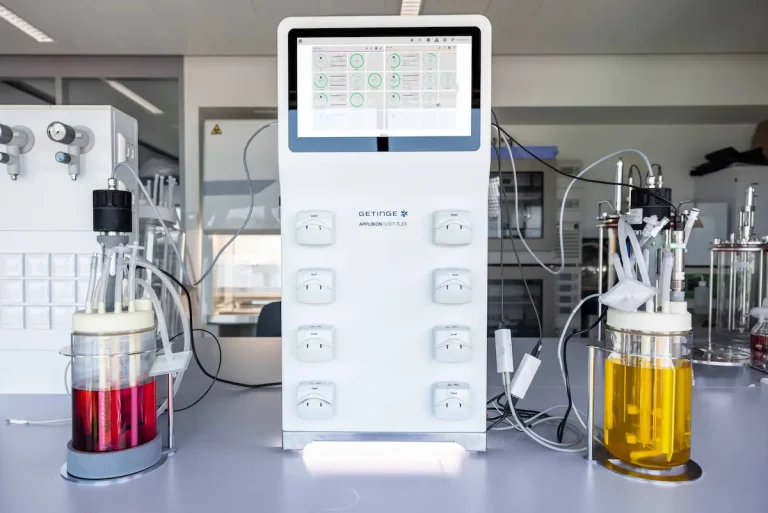
A bioreactor system always consists of two parts — the reactor vessel and the control unit.
The reactor vessel
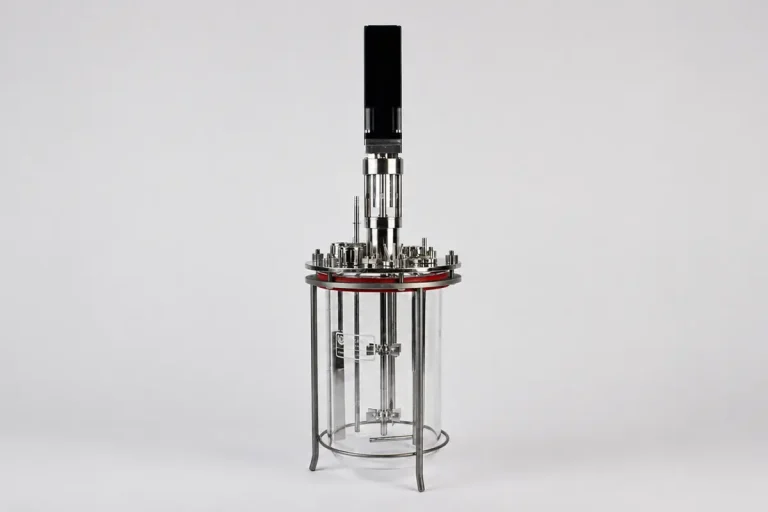
The reactor vessel can be made of glass, stainless steel or plastic (single-use). Depending on the type, it consists of different components. Below is an overview of the most common components.
- Vessel and headplate: an autoclavable glass bioreactor, stainless-steel vessel or single-use vessel. The headplate contains all connections for probes, addition lines and gas supply. In some cases, addition and sampling can also be applied via side or bottom connections.
- Agitation system: magnetically or directly coupled via a lip seal, with impellers adapted to the organism — gentle for mammalian cells and high-performance for microbial fermentations.
- Gas supply: a sparger or overlay gas line introduces air, oxygen, nitrogen or CO₂ into the liquid.
- Temperature control: single-walled using a heating jacket & cooling finger, or a double-jacketed vessel with a thermostat. In small bioreactor systems, cooling and heating can also be provided using a Peltier module.
- Exhaust gas condenser: prevents volume loss and keeps the system closed.
- Probes: pH, dissolved oxygen (dO₂), temperature and, if required, additional measurements such as level, exhaust gas, foam, pressure, biomass or CO₂, and much more.
Vessel material
Glass, stainless steel or plastic
The vessel material determines how a process is prepared, sterilised and changed over.
Glass is the most widely used material at laboratory scale. The process remains visible, the vessel is sterilised in an autoclave and reused for many runs. Getinge Applikon offers autoclavable glass reactors with total volumes from 2 to 20 L, either single-walled or double-jacketed for temperature control via a thermostat. The limitations are pressure and volume.
Stainless steel is used for larger volumes when in-situ sterilisation (SIP) or higher operating pressures are required. These systems are permanently installed, robust and durable, but require more infrastructure — steam, cooling water and cleaning circuits. Getinge Applikon offers systems from 30 L to 5,000 L.
The disposable vessel arrives at the customer’s site gamma-sterilised, is used for cultivation and disposed of after the run. This significantly reduces preparation time and considerably lowers the risk of cross-contamination. However, the running costs per batch are higher, and the availability of consumables must be taken into account. The AppliFlex ST covers this range from 500 mL to 15 L.
The control unit
The controller unit links the measurement with the process control. It performs five tasks:
- Control of actuators — pumps, valves, mass flow controllers, agitator, heating
- Process control using defined control loops. Optionally apply recipe functions in case of extended controller.
- Recording & visualisation of process data as numerical values and trend curves
- Alarms when values deviate from their setpoints
- Data interface to SCADA or PIMS software for data recording and advanced control strategies
For Getinge Applikon systems, the range extends from the my-Control for small working volumes to the Livit Flex, which supports multiple and single-use reactors on a shared platform.
The control loop — the principle behind it
Every controlled parameter follows the same closed-loop process:
-
Sensor measures the actual value
in the bioreactor -
Controller compares it with the defined setpoint
-
Actuator is activated and changes the process
-
Probe measures again
Practical tip from the Resea team
