Applikon BioSep Perfusion System – Vendor-Independent Cell Retention for Any Bioreactor.

The Applikon BioSep is a breakthrough cell-retention device for high-density perfusion bioprocesses — engineered around resonant ultrasonic technology instead of the mesh and membrane systems that dominate the rest of the perfusion market. The result: non-fouling, non-clogging, cell-friendly perfusion with separation efficiency above 95% that sustains continuous cultivation for over six months. Available in three sizes (10 L, 50 L, 200 L) and compatible with any bioreactor brand, the BioSep is the perfusion device of choice for cGMP-grade biopharmaceutical production, cell and gene therapy manufacturing, and any application where extended perfusion uptime and product quality matter more than the bioreactor it sits beside. 

The Applikon BioSep in detail.

The Applikon BioSep is a cell-retention device for perfusion bioprocesses — the component that turns a stirred-tank bioreactor running batch or fed-batch into a fully continuous, high-density perfusion system. Unlike mesh-, membrane- or hollow-fibre-based cell-retention technologies, the BioSep uses high-frequency resonant ultrasonic waves to separate cells from the harvest stream — a fundamentally different physical principle that eliminates the fouling, clogging and cell-damage issues that plague filter-based perfusion systems. The result is a perfusion device that runs uninterrupted for over six months, delivers above 95% separation efficiency, and maintains cell viability across the full campaign duration.

Experience and quality in every detail.

The BioSep is engineered by Applikon, the worldwide reference in bioprocess instrumentation, with decades of experience supplying universities, biotech start-ups and biopharmaceutical organisations across the globe. Where most of Applikon’s product family covers vessel platforms — from the MiniBio and Applikon Autoclavable Glass Bioreactor through to the BioBench, BioPilot and BioProduction stainless-steel systems — the BioSep is the perfusion technology that complements all of them. Resea Biotec is the official Swiss distributor and certified service partner.

Easy operation with professional process control.

The BioSep operates on the principle of acoustic resonance. The Resonator Chamber sits in the bioreactor’s perfusion loop, with the cell suspension pumped in by a circulation pump and split into a harvest flow and a return flow. Inside the chamber, high-frequency resonant ultrasonic waves generate acoustic forces that aggregate the suspended cells and hold them stationary against the flow — clarifying the harvest stream while letting the planar aggregates of cells recycle back to the bioreactor for continued cultivation.

The mechanical implication is significant. There is no filter, no mesh, no membrane in the cell path. The acoustic field does the work that physical media do in conventional systems — and because nothing in the device traps cells against a surface, the BioSep cannot foul, cannot clog, and does not exert the shear and pressure forces that damage cells in filter-based perfusion. The same chamber that runs day one of a campaign runs day 180 with no separation-efficiency drop, no cleaning interruption and no maintenance window.

Available BioSep sizes:

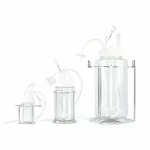
The BioSep is available in three sizes to match the working volume of your bioreactor — from bench-scale process development through to pilot and small-commercial production.

  1. 1 BioSep 10 L — bench-scale — working volume 1–10 L.
  2. 2 BioSep 50 L — pilot-scale — working volume 5–50 L.
  3. 3 BioSep 200 L — pilot and small-commercial — working volume up to 200 L.

All three BioSep sizes share the same acoustic-resonance technology, the same operating principle and the same control architecture — so a perfusion process developed on the BioSep 10 L scales onto the BioSep 50 L and 200 L without changing the perfusion fundamentals.

Acoustic perfusion — beyond mesh and membrane

Most perfusion devices use a physical separation medium — mesh filters, hollow-fibre membranes, or tangential-flow filtration cartridges. They work, but they share a structural weakness: cells contact the medium, and over time the medium fouls, clogs, or shears the cells passing through it. Long campaigns become a balance between perfusion uptime and the moment the filter fails, and most filter-based perfusion programmes plan around 30–60-day campaign windows for that reason.

The BioSep doesn’t have this problem because it doesn’t have a filter. High-frequency resonant ultrasonic waves generate stationary nodes that aggregate cells in mid-stream, with the harvest fluid flowing freely past them. Nothing physical traps the cells; nothing physical can foul. Campaigns running six months or longer are routine, and the gentle acoustic forces preserve cell viability across the full duration — meaning higher productivity, higher product quality and lower risk of campaign-end failure compared to filter-based alternatives.

For applications where product quality, campaign uptime and process stability matter more than capital cost, acoustic perfusion is structurally the better technology. The BioSep is the most widely deployed acoustic-perfusion system in bioprocessing.

Built for cGMP, validated for long campaigns

The BioSep is proven under cGMP conditions — rigorously tested and validated for compliance with current Good Manufacturing Practice standards. The acoustic-resonance principle delivers separation efficiency above 95% consistently across the full campaign, with continuous cultivation supported for over six months in deployed production environments. Because the device is filter-free, there are no replacement filters in the validation lifecycle — the same Resonator Chamber that’s qualified at start-up runs the entire campaign.

For biopharmaceutical production, cell and gene therapy manufacturing, vaccine and viral-vector workflows, that translates into shorter validation cycles, fewer change controls and a more predictable cost profile across the campaign. Bioreactor-agnostic compatibility is the other operational advantage: the BioSep integrates with any bioreactor brand, so the perfusion technology travels with your process even if your bioreactor platform changes between facilities.

applikon biosep
Workflows

What is the BioSep workflow?

The BioSep workflow runs in three phases.
Integrate. Connect the BioSep to your existing bioreactor through the perfusion loop — no platform-specific adapter required, regardless of bioreactor brand. The Resonator Chamber sits between the harvest line and the return line, with the circulation pump driving cell suspension through the chamber. The BioSep pairs natively with the full Applikon bioreactor family MiniBio and Applikon Autoclavable Glass Bioreactor at lab scale, BioBench and BioPilot at bench and pilot scale, and the AppliFlex ST single-use range across all volumes — as well as with any third-party bioreactor where high-density perfusion is required. Resea Biotec’s specialists work through the integration with you to match the BioSep size to your bioreactor working volume.

Operate. Run the perfusion campaign at your target cell density. Acoustic forces aggregate cells inside the Resonator Chamber, harvest fluid clarifies and exits the system, and planar cell aggregates recycle back to the bioreactor for continued cultivation. The control architecture integrates with your existing bioprocess controller — no separate operating environment to learn. The BioSep supports the full range of high-density perfusion applications: monoclonal antibody production, viral-vector manufacturing, vaccine cell-culture, stem-cell expansion, regenerative medicine, mRNA processes and cell-and-gene therapy bioprocesses. The continuous nutrient supply and continuous waste removal that perfusion enables drive enhanced cell densities, longer culture durations and improved product quality compared to batch or fed-batch operation.

Sustain. Run for the full campaign duration — typically months rather than weeks. Because there is no filter to foul or clog, there is no scheduled maintenance window inside the campaign. The same chamber that runs day one runs day 180 with no separation-efficiency drop, no cleaning-cycle interruption and no media replacement. Where a stirred-tank bioreactor on its own delivers a cell-culture environment, a stirred-tank bioreactor paired with a BioSep delivers a continuous bioprocessing platform.

Why use the BioSep?

  •  Resonant ultrasonic technology — non-fouling, non-clogging perfusion with no filter to replace and no membrane to foul.
  • Above 95% separation efficiency, sustained for 6+ months — proven under cGMP conditions, validated for clinical and commercial bioprocesses.
  •  Full range of high-density applications — monoclonal antibodies, viral vectors, vaccines, stem-cell expansion, regenerative medicine, mRNA and cell-and-gene therapy.
  • Bioreactor-agnostic compatibility — integrates with any bioreactor brand, not just Applikon, so the perfusion technology travels with your process.
  • Cell-friendly operation — gentle acoustic forces preserve cell viability across the full campaign, supporting higher product quality than mesh and membrane alternatives.

Spec your BioSep with Resea Biotec

The Applikon BioSep is a cell-retention perfusion device using acoustic-resonance technology, available in 10 L, 50 L and 200 L sizes — covering the full path from bench-scale process development through to pilot and small-commercial perfusion production. Non-fouling, non-clogging, with above 95% separation efficiency sustained for 6+ months and full bioreactor-agnostic compatibility across the Applikon family (MiniBio, Applikon Autoclavable Glass Bioreactor, AppliFlex ST, BioBench, BioPilot) and any third-party stirred-tank platform.

Perfusion is where bioprocess uptime, product quality and campaign economics meet — and the choice of cell-retention technology shapes all three. Resea Biotec is Switzerland’s official Applikon distributor and certified service partner — based in Recherswil, supporting customers across Switzerland with local technical support and on-site service.

Talk to our team and we’ll spec the right BioSep size to match your bioreactor, support the integration into your existing perfusion loop, and stay on hand for application and maintenance support throughout the system’s life. Whether you’re running your first perfusion campaign, scaling an established process from bench through pilot, or extending campaign duration on an existing stirred-tank platform — our specialists work the configuration through with you end to end.

Contact us
Bio-sep
Resources

BioSep datasheets & technical resources

Product specifications, application data and integration guidance for the Applikon BioSep acoustic-resonance perfusion device.

Applikon BioSep — Perfusion device datasheet.

Specifications, working volumes, separation efficiency and integration overview for the BioSep 10 L, 50 L and 200 L sizes.

PDF • 2.1 MB
Download

Applikon BioSep — Application brochure.

Real-world perfusion applications, technology background, performance data and case studies across cGMP-grade biopharmaceutical, cell-and-gene therapy and stem-cell production.

PDF • 5.7 MB
Download
CTA Background

Looking for the Right Bioprocess Solution?

Our specialists support you throughout the entire bioprocess lifecycle — from system selection and application design to implementation, optimization, and long-term operation. We work closely with you to ensure reliable, compliant, and scalable solutions tailored to your requirements.

Talk to Our Experts
Contact Form EN
Request Product

Request Product

Fill out the form and our team will get back to you shortly.

Contact Information