Inside the AppliSens Smart DO₂ Sensor.
The AppliSens Smart DO₂ Sensor brings Applikon’s polarographic measurement experience to the bioreactor port in a deceptively simple form: a Clark-type DO probe, an analog nA output, a VP8 connector — and decades of process know-how about how to keep all three drift-low across long autoclave cycles, cell-culture runs and fermentation campaigns. Whether you’re monitoring oxygen uptake in a microbial fed-batch, validating a perfusion setup in stainless steel, or running screening work on AppliFlex ST single-use vessels, the AppliSens Smart DO₂ delivers reliable dissolved-oxygen readings on the Livit Flex platform with the kind of operational consistency that lets you actually trust the data.
Designed and built by Applikon.
The AppliSens Smart DO₂ Sensor is engineered by Applikon, the worldwide reference in bioprocess instrumentation, with decades of field-proven experience supplying universities, biotech start-ups and biopharmaceutical organizations across the globe. The polarographic Clark-type principle has been the workhorse of dissolved-oxygen sensing in bioprocessing for generations — the AppliSens Smart DO₂ is the modern, drift-optimized expression of that principle, paired with the VP8 connector for direct integration into Livit Flex bioprocess controllers. Resea Biotec is the official Swiss distributor and certified service partner.
Clark-type measurement and VP8 connectivity.
The AppliSens Smart DO₂ Sensor measures dissolved oxygen using a Clark-type polarographic cell: oxygen diffuses through the sensor membrane, is reduced at the cathode, and generates a measurable nA current proportional to oxygen partial pressure in the medium. The drift-low design keeps the relationship stable across the full process window — typically 33–66 nA at air saturation (25 °C, 1,013 bar, 100% RH) — with ± 0.1% measurement accuracy.
Signal delivery runs through the VP8 connector, the industrial standard for bioprocess sensors and the native input format on Applikon’s Livit Flex controller. Plug, calibrate, run — no signal-conversion modules, no proprietary cabling, no integration unknowns.
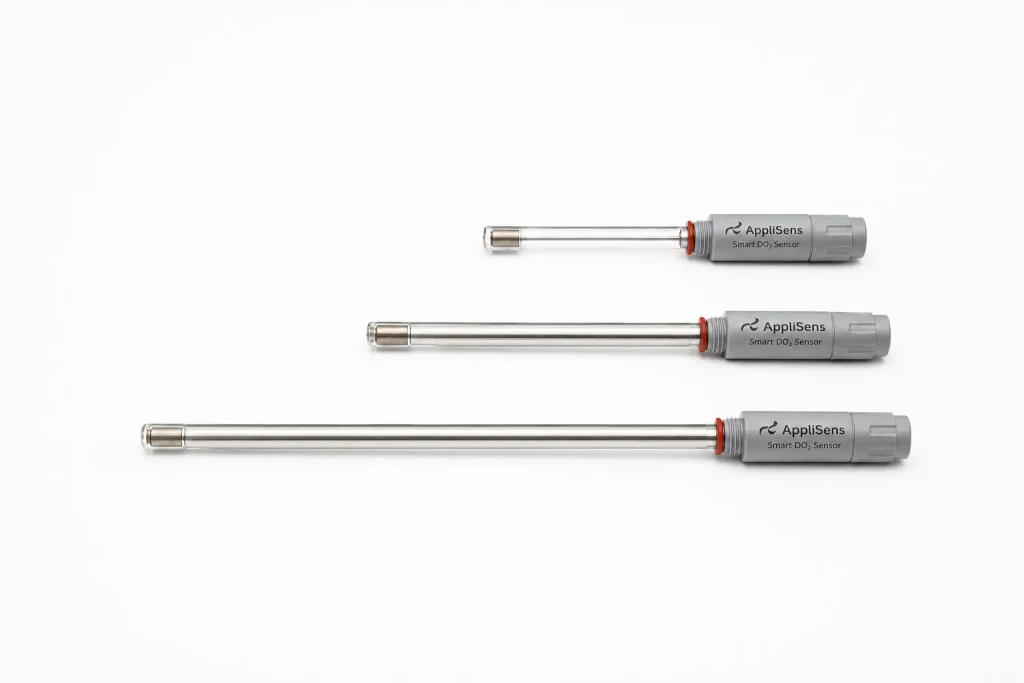
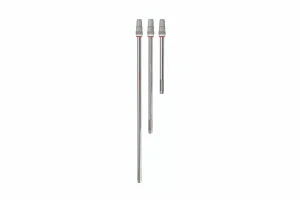
Four insertion lengths for each Applikon vessel.
The AppliSens smart DO₂ sensor is available in four insertion lengths to match every standard Applikon vessel from lab scale through pilot, and most third-party bioreactors using PG 13.5 ports. The 12 mm probe diameter is consistent across the range — every length installs through the same standardised port, and pairs with the Livit Link transmitter for direct integration with the Livit Flex bioprocess controller.
235 mm — lab-scale
- 1 AppliFlex ST 2 L and 3 L single-use bioreactors.
- 2 Small Glass Autoclavable Bioreactor vessels.
325 mm — mid-range lab-scale
- 1 Mid-range Glass Autoclavable Bioreactor vessels.
- 2 AppliFlex ST 15 L single-use bioreactor.
425 mm — bench-scale stainless and larger Applikon Autoclavable Glass Bioreactor.
- 1 Applikon BioBench stainless-steel bioreactor.
- 2 Larger Glass Autoclavable Bioreactor vessels.
590 mm — pilot-scale stainless
- 1 Applikon BioPilot pilot-scale stainless-steel bioreactor.
The 12 mm probe diameter is consistent across the range, and every length pairs with the same Livit Link transmitter for Livit Flex integration. The smart DO₂ is not currently offered in MiniBio-compatible insertion lengths — for MiniBio screening applications, the AppliSens DO₂ classic polarographic line provides the smaller-length variants.
| Cell Type | Cell Culture and Microbial Other Cell Culture Microbial |
| Technology Platform | Multi-Use |
| Insertion lengths in mm | 110 235 325 425 590 |
| Thread Type | PG 13.5 PG 13.5, free spinning |
| Measured Parameter | Dissolved Oxygen |
| Connector Type | VP8 |
| Diameter | 12 mm |
| Measurement range | 33-66 nA @ Air / 25 °C / 1.013 bar / 100%RH |
| Measurement Accuracy (±) | ± 0.1 % |
| Sensors Autoclavable | Yes |
| Sensors Max sterilization temperature | 135 °C |
| Measurement principle | Clark-type polarographic low drift DO sensor |
| Reference System | Air/O₂ |
| Communication type | Analog nA |
| Sensors Compatible bioreactors | Applikon Autoclavable Glass Bioreactor Applikon BioBench Stainless Steel Bioreactor Applikon BioPilot Stainless Steel Bioreactor Applikon MiniBio Bioreactor AppliFlex ST single use-Bioreactors |
| Controller (compatible) | Applikon Livit Flex Bioprocess Controller |
| PAT-enabled (sensors) | Yes |
Research & Process Development
Early-stage process characterisation runs across the bioprocess-relevant DO range with ± 0.1 % measurement accuracy and the polarographic Clark electrode principle’s proven reliability across cell-culture and fermentation chemistries. Pre-calibration in a controlled environment — possible thanks to the integrated sensor chip’s calibration data storage — lets development teams move sensors between bioreactor stations without recalibration interruptions, particularly valuable for parallel-bioreactor DoE work and screening campaigns.
Screening & Optimization
The same smart DO₂ architecture moves between Applikon Autoclavable Glass Bioreactor, AppliFlex ST single-use (2 L through 15 L), BioBench stainless-steel and BioPilot pilot vessels — four insertion lengths (235 / 325 / 425 / 590 mm) at the consistent 12 mm probe diameter, with PG 13.5 ports across the range. The Livit Flex’s parallel-bioreactor orchestration runs the same smart DO₂ model across every vessel in the screening matrix. Note: the smart DO₂ does not cover MiniBio screening — for MiniBio applications, the AppliSens DO₂ classical polarographic line provides the smaller-length variants.
GMP Transition
The transition from research workflows into regulated process development asks one question of every sensor on the platform — does it inherit the validation chain, or does it require a parallel one? The AppliSens smart DO₂ inherits. VP8 connector + Livit Link transmitter + USB-C cable delivers the sensor signal into the Livit Flex’s native DO input with no signal-conversion module, no parallel sensor-management software stack, and the integrated pt1000 temperature sensor handles temperature compensation natively. The DO measurement layer carries the same audit-trail architecture as the rest of the AppliSens stack.
GMP Manufacturing
Pilot through full-scale cGMP production runs on the BioPilot (30–270 L) at 590 mm insertion length, with autoclavable to 135 °C sterilisation tolerance for high-SIP-frequency campaign environments. The autoclavable polarisation module polarises the sensor during the autoclave cycle itself — eliminating the 6-hour post-autoclave polarisation step that classical polarographic DO sensors require — a real start-up time reduction that compounds across the weekly or sub-weekly sterilisation cycles cGMP campaigns demand.
Compatible controller
Compatible Bioreactor
- Applikon Autoclavable Glass Bioreactor The Applikon Autoclavable Glass Bioreactor is a stirred tank bioreactor designed…
- Applikon BioBench Stainless Steel Bioreactor The Applikon BioBench is a stainless steel bioreactor system designed for simple…
- Applikon BioPilot Stainless Steel Bioreactor The Applikon BioPilot is a stainless steel bioreactor system for simple and reli…
- AppliFlex ST Single-Use Bioreactor The Applikon AppliFlex ST is a fully customizable single-use stirred tank biorea…
Compatible sensors
Compatible software
-
Mammalian Cells
Mammalian cells have become the linchpin in the production of recombinant glycoproteins such as hormones, enzymes, cytokines, and antibodies, all of which play pivotal roles in human therapy.
Learn More -
Stem Cells
Stem cells represent a pioneering achievement in biomedical research and therapy, offering unprecedented opportunities for regenerative medicine, including tissue engineering and the treatment of various diseases.
Learn More -
Microbials
In the field of industrial microbiology, the cultivation of microorganisms through bioreactor fermentation stands as a cornerstone technique for producing a broad spectrum of microbial products, from antibiotics, biofuels to food and beverages
Learn More -
Plant Cells and Algae
At the forefront of sustainable biotechnology, the cultivation of plant cells and algae within bioreactors presents a revolutionary approach to producing valuable biochemicals, pharmaceuticals, and biofuels
Learn More -
Insect Cells
In the rapidly evolving landscape of biotechnology, the Baculovirus Expression Vector System (BEVS) with insect cells stands out as a versatile and powerful tool for protein production.
Learn More
-
Cellular Agriculture
Cellular agriculture represents a groundbreaking shift in food production, centering around the concept of cellular food solutions. This innovative field harnesses biotechnology to cultivate animal and plant cells for food, directly in a controlled environment, bypassing traditional farming methods.
Learn More -
Biotherapeutics
Discover biologicals, where innovation meets healthcare to revolutionize treatment methodologies and patient care. Biotherapeutics include a broad range of biologically derived products, such as monoclonal antibodies (mABs), viral vectors, and vaccines, each playing a pivotal role in targeted disease treatment and prevention.
Learn More -
Cell and Gene Therapy
Cell and gene therapy is revolutionizing modern medicine. For the safe development and manufacturing of these therapies, Resea Biotec bioreactors provide the ideal controlled environment, guaranteeing precision, scalability, and efficiency in the production process.
Learn More
Polarographic precision, run after run.
What distinguishes the AppliSens Smart DO₂ Sensor from generic DO probes is operational consistency over the long haul. The drift-low Clark-type design holds its calibration through repeated autoclave cycles, and the polarographic measurement principle remains stable across the full range of cell-culture and microbial fermentation conditions. For process development teams that need to compare runs across weeks or months, this consistency is what makes data comparison meaningful — not just current, but campaign-to-campaign.
The analog nA output is read directly by the Livit Flex controller and integrated into the standard PAT data stream. No signal conversion modules. No proprietary translation layer between sensor and controller. The sensor’s value reaches your controller, your historian and your data scientists in exactly the form Applikon designed.
Built for autoclaving — sterilization to 135 °C.
The AppliSens smart DO₂ sensor is rated for autoclave sterilisation up to 135 °C — well above the 121 °C / 20-minute standard cycle, with margin for extended cycles, higher-temperature protocols or repeated SIP exposure across the campaign year. The sensor stays in the vessel through every sterilisation cycle, eliminating the aseptic-transfer steps that are otherwise required when using non-autoclavable DO probes.
For regulated environments, this matters operationally. Every autoclave cycle that doesn’t require sensor removal and re-installation is one less sterile-boundary breach in the SOP, one less aseptic-transfer log entry, one less opportunity for contamination, and one less validation event to document. Across a campaign year — particularly in cGMP environments running weekly or sub-weekly sterilisation cycles — that compound saving in operator time, documentation overhead and contamination risk becomes material. The autoclavable polarisation module is engineered for that sterilisation cycle frequency, polarising the sensor during the autoclave cycle itself rather than requiring a separate six-hour polarisation step after sterilisation — a real start-up time reduction that compounds across high-cadence development campaigns.
The AppliSens Smart DO₂ workflow in three phases.
Install. Select the insertion length matching your vessel, choose fixed or rotatable PG 13.5 thread, and seat the sensor through the head-plate port. The VP8 connector mates directly with the Livit Flex sensor input — no signal converter, no calibration of the connection itself.
Calibrate and run. Two-point calibration on Livit Flex (zero in nitrogen-saturated buffer or sodium sulfite; 100% in air-saturated medium at process temperature) establishes the working range. From there, the sensor reads continuously through the autoclave cycle, inoculation and the full run — typically 33–66 nA at air saturation, with ± 0.1% measurement accuracy maintained across the process window.
Sterilize and reuse. Autoclave the assembled vessel with the sensor in place, up to 135 °C. After the run, clean via Applikon’s maintenance schedule and re-calibrate for the next campaign. The Multi-Use platform supports many cycles before electrolyte refresh or membrane replacement is required.
Highlights of the AppliSens Smart DO₂ Sensor.
- Clark-type polarographic measurement — drift-low design with ± 0.1% accuracy across the full air-saturation window.
- VP8 connector, Livit Flex native — direct plug-and-measure integration with the Applikon controller platform, no signal converters.
- Five insertion lengths — 110, 235, 325, 425 and 590 mm, covering MiniBio through BioPilot.
- Autoclavable to 135 °C — sensor stays in the vessel through sterilization, no aseptic re-installation.
Spec your AppliSens Smart DO₂ Sensor with Resea Biotec.
The AppliSens smart DO₂ is the polarographic DO sensor most labs choose when on-board sensor diagnostics and pre-calibration matter as much as the measurement itself — the integrated sensor chip stores calibration parameters (offset, slope, sample corrections, uptime and sensor health), so the sensor can be pre-calibrated in a controlled environment and connected to field systems without recalibration on transfer. The polarographic Clark electrode principle paired with a titanium membrane module delivers the long-term drift profile that bioprocess DO measurement requires, and the autoclavable polarisation module polarises the sensor during the autoclave cycle itself rather than requiring a separate 6-hour polarisation step after sterilisation. Four insertion lengths (235 / 325 / 425 / 590 mm) at 12 mm probe diameter cover Applikon Autoclavable Glass Bioreactor, AppliFlex ST single-use, BioBench and BioPilot, with the PG 13.5 thread consistent across the range.
A DO sensor change is rarely just a sensor change — it lands inside an existing controller stack, an existing calibration cadence and an existing service contract, and the integration work is what determines whether the upgrade actually delivers. The AppliSens smart DO₂ fits inside the AppliSens stack on the Livit Flex through the Livit Link transmitter and USB-C cable — the pairing chain that unlocks the smart functionality (pre-calibration data, sensor health, integrated temperature compensation) without a parallel sensor-management software stack. Choosing the right insertion length and thread variant for your vessel matters — undersize the length and the membrane sits above the working volume; oversize it and the probe interferes with the impeller. Resea Biotec is Switzerland’s official Applikon distributor and certified service partner — based in Recherswil, supporting customers across Switzerland with technical support and on-site service.
Talk to our team and we’ll spec the right AppliSens smart DO₂ length and thread combination for your bioreactor, plan the Livit Link transmitter pairing on your existing Livit Flex setup, advise on the pre-calibration workflow for your campaign profile, and stay on hand for application and maintenance support throughout the sensor’s life. Whether you’re moving a long mammalian cell culture campaign onto smart-sensor-diagnostic infrastructure, building out an AppliSens-native sensor bench with smart DO₂ alongside AppliSens smart pH on the same Livit Flex, or transitioning a high-cadence development environment where pre-calibration eliminates the 6-hour post-autoclave polarisation delay — we’ll help you spec the right combination end to end.