AppliSens Smart pH Sensor – pH 2–9 with VP8 Connector for Livit Flex.

The AppliSens Smart pH Sensor is a potentiometric combination glass-electrode pH probe with a VP8 connector, engineered by Applikon for direct integration with the Livit Flex bioprocess controller and the full Applikon vessel range — Glass Autoclavable, BioBench, BioPilot, MiniBio and AppliFlex ST. Measurement range pH 2–9 with ± 0.01 pH accuracy, an Ag/AgCl/KCl-saturated reference system, autoclave sterilisation to 135 °C, and seven insertion lengths (110, 120, 155, 235, 325, 425 and 590 mm) for screening, process development and pilot-scale work.

 A closer look at the AppliSens Smart pH Sensor.

The AppliSens Smart pH Sensor brings Applikon’s potentiometric measurement expertise to the bioreactor port in a form that prioritises operational consistency over the long haul: a combination glass electrode, an Ag/AgCl/KCl-saturated reference system, an analog mV output via VP8 — and the calibration stability that lets you actually trust the readings two weeks into a perfusion run. Whether you’re holding mammalian cell culture at pH 7.0 ± 0.05, driving a microbial fermentation through an aggressive pH swing, or characterising a new bioprocess on the AppliFlex ST single-use platform, the AppliSens Smart pH delivers ± 0.01 pH accuracy on the Livit Flex platform — the kind of reliability that lets you treat pH as a controlled variable rather than a moving target.

Engineered by Applikon, refined for bioprocessing.

The AppliSens Smart pH Sensor is engineered by Applikon, the worldwide reference in bioprocess instrumentation, with decades of field-proven experience supplying universities, biotech start-ups and biopharmaceutical organisations across the globe. The potentiometric glass-electrode principle is the established standard for bioprocess pH measurement — the AppliSens Smart pH is the modern, drift-optimised expression of that standard, paired with an Ag/AgCl/KCl-saturated reference system and a VP8 connector for direct integration into Livit Flex bioprocess controllers. Resea Biotec is the official Swiss distributor and certified service partner.

Potentiometric measurement and digital signal path.

The AppliSens Smart pH Sensor measures pH using a combination glass electrode: the pH-sensitive glass membrane develops a voltage proportional to the hydrogen-ion activity in the medium, measured against an Ag/AgCl/KCl-saturated reference system. The potentiometric principle generates an analog mV signal across the measurement range of pH 2–9, with ± 0.01 pH accuracy held across the full process window.

Signal delivery runs through the VP8 connector, the industrial standard for bioprocess sensors and the native input on Applikon’s Livit Flex controller. The analog mV signal flows directly into the controller — no signal-conversion modules, no proprietary cabling, no integration unknowns. The same sensor reads identically on every Livit Flex in the lab.

Seven insertion lengths, one sensor family.

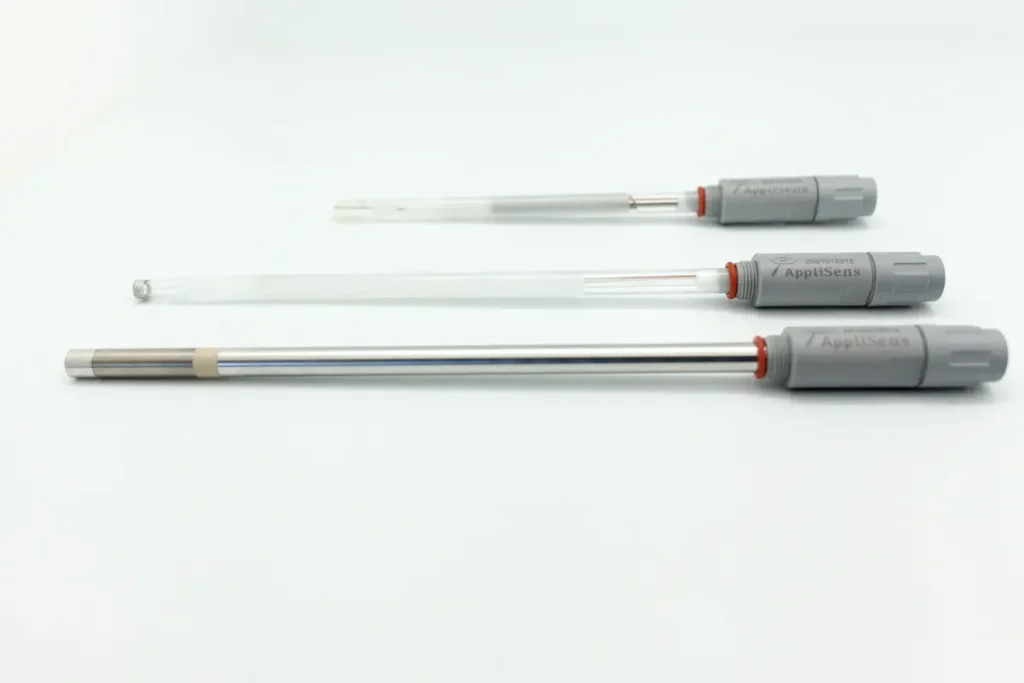
The AppliSens smart pH sensor is available in seven insertion lengths to match every Applikon vessel and most third-party bioreactors using PG 13.5 ports. The 12 mm probe diameter is consistent across the range — every length installs through the same standardised port.

110 mm — small benchtop

  1. 1 MiniBio Bioreactor (250 mL – 1 L).
  2. 2 AppliFlex ST 500 mL single-use.

120 mm — short-fill MiniBio and specialised low-volume vessels.

  1. 1 Short-fill MiniBio configurations.
  2. 2 Specialised low-volume vessels.

155 mm — extended-MiniBio and small single-use

  1. 1 MiniBio Plus.
  2. 2 AppliFlex ST 2 L single-use.

235 mm — lab-scale single-use and small Applikon Autoclavable Glass Bioreactor.

  1. 1 AppliFlex ST 3 L single-use.
  2. 2 Small Glass Autoclavable Bioreactor vessels.

325 mm — mid-range Applikon Autoclavable Glass Bioreactor and lab-pilot single-use.

  1. 1 Mid-range Glass Autoclavable Bioreactor vessels.
  2. 2 AppliFlex ST 15 L single-use.

425 mm — bench-scale stainless and larger Applikon Autoclavable Glass Bioreactor.

  1. 1 Applikon BioBench stainless-steel bioreactor.
  2. 2 Larger Glass Autoclavable Bioreactor vessels.

590 mm — pilot-scale stainless.

  1. 1 Applikon BioPilot pilot-scale stainless-steel bioreactor.

The 12 mm probe diameter is consistent across the range — every length installs through the standard PG 13.5 port, with full Applikon controller auto-recognition through the AppliSens driver across the lab-to-pilot vessel range.

Stable pH readings across cell culture and fermentation.

What distinguishes the AppliSens Smart pH Sensor from generic pH probes is calibration stability under real bioprocess conditions. The Ag/AgCl/KCl-saturated reference system is designed to resist drift across long autoclave cycles, repeated steam-in-place exposure and the chemical environments of both cell-culture and microbial fermentation media. For perfusion processes running 14 to 30 days, this stability is the difference between a pH set-point that drifts noticeably over the run and one that holds for the full campaign.

The analog mV output is read directly by the Livit Flex controller and integrated into the standard PAT data stream. No signal-conversion modules. No proprietary translation layer between sensor and controller. The pH value reaches your controller, your historian and your data scientists exactly as Applikon designed it.

AppliSens Smart pH Sensor

Autoclavable sensor for sterile Applications

The AppliSens smart pH sensor is rated for autoclave sterilisation up to 135 °C — well above the 121 °C / 20-minute standard cycle, with margin for extended cycles, higher-temperature protocols or repeated SIP exposure across the campaign year. The sensor stays in the vessel through every sterilisation cycle, eliminating the aseptic-transfer steps that are otherwise required when using non-autoclavable pH probes.

For regulated environments, this matters operationally. Every autoclave cycle that doesn’t require sensor removal and re-installation is one less sterile-boundary breach in the SOP, one less aseptic-transfer log entry, one less opportunity for contamination, and one less validation event to document. Across a campaign year — particularly in cGMP environments running weekly or sub-weekly sterilisation cycles — that compound saving in operator time, documentation overhead and contamination risk becomes material. The titanium and PEEK construction with fully electropolished surfaces is engineered for that sterilisation cycle frequency, with the smart sensor architecture logging every autoclave exposure into the sensor’s on-board service history.

AppliSens Sensor
WORKFLOW

Installation, calibration and reuse — the AppliSens Smart pH workflow.

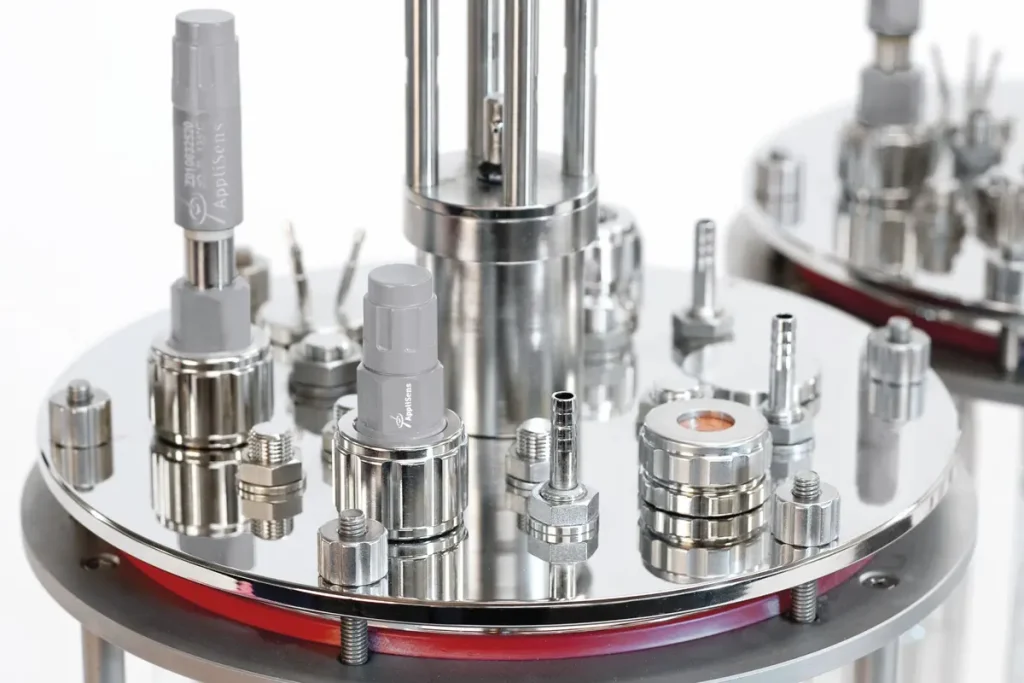
Install. Select the insertion length matching your vessel, choose fixed or freely rotatable PG 13.5 thread, and seat the sensor through the head-plate port. The VP8 connector mates directly with the Livit Flex sensor input — no signal converter, no calibration of the connection itself.

Calibrate and run. Two-point calibration on Livit Flex using standard pH 4.01 and pH 7.00 buffers — with optional three-point extension to pH 9.00 for elevated-pH applications — establishes the working slope. From there, the sensor reads continuously through the autoclave cycle, inoculation and the full run, with ± 0.01 pH accuracy maintained across the process window.

Sterilise and reuse. Autoclave the assembled vessel with the sensor in place, up to 135 °C. After the run, clean and store per Applikon’s maintenance schedule and re-calibrate for the next campaign. The Multi-Use platform supports many cycles before reference electrolyte refresh is required.

What you get with the AppliSens Smart pH Sensor.

  • Potentiometric measurement, ± 0.01 pH accuracy — combination glass electrode with Ag/AgCl/KCl-saturated reference across pH 2–9.
  • VP8 connector, Livit Flex native — direct plug-and-measure integration with the Applikon controller platform, no signal converters.
  • Seven insertion lengths — 110, 120, 155, 235, 325, 425 and 590 mm, covering MiniBio through BioPilot.
  • Autoclavable to 135 °C — sensor stays in the vessel through sterilisation, no aseptic re-installation.

Spec your AppliSens Smart pH Sensor with Resea Biotec.

The AppliSens smart pH is the pH sensor most labs choose when on-board sensor diagnostics matter as much as the measurement itself — the smart sensor architecture continuously logs calibration history, autoclave cycle count and reference-junction status, and reports them through the same Applikon controller channel that drives the rest of the bioprocess. Autoclavable to 135 °C with the sensor in place — well above the standard 121 °C cycle, with margin for extended SIP exposure across the campaign year. Seven insertion lengths (110 / 120 / 155 / 235 / 325 / 425 / 590 mm) covering Applikon MiniBio through to BioPilot pilot scale, with the 12 mm probe diameter consistent across the range — every length installs through the standard PG 13.5 port, with full Applikon controller auto-recognition through the AppliSens driver.

Choosing the right insertion length for your vessel matters — undersize and the electrode tip sits above the working volume; oversize and the probe interferes with the impeller. A pH sensor change is rarely just a sensor change — it lands inside an existing controller stack, an existing calibration cadence and an existing service contract, and the integration work is what determines whether the upgrade actually delivers. The AppliSens smart pH fits inside the AppliSens stack rather than asking the lab to add a parallel one. Resea Biotec is Switzerland’s official Applikon distributor and certified service partner —  based in Recherswil, supporting customers across Switzerland with local stock, German-language technical support and on-site service.

Talk to our team and we’ll spec the right AppliSens smart pH length and thread combination for your bioreactor, plan the AppliSens driver activation across your existing controller fleet, advise on the calibration buffer workflow for your application, and stay on hand for application and maintenance support throughout the sensor’s life. Whether you’re moving a long mammalian cell culture campaign onto smart-sensor-diagnostic infrastructure, building out an AppliSens-native sensor bench with smart pH alongside AppliSens LumiSens or AppliSens DO₂, or transitioning a fermentation process where on-board calibration history simplifies the GMP documentation chain — we’ll help you spec the right combination end to end.

Contact us
AppliSens Smart pH Sensor
Resources

AppliSens smart pH datasheet & technical resources

Product specifications, Livit Link transmitter integration, on-board calibration data storage and full insertion-length range for the AppliSens smart pH sensor — alongside the complete AppliSens sensor family (LumiSens, pH+, smart DO₂, DO₂).

AppliSens Sensors — Manufacturer’s bioprocess sensor catalogue.

The complete AppliSens bioprocess sensor catalogue covering the smart pHLumiSens optical DO₂ (RedFlash), pH+smart DO₂DO₂, and RedOx sensors. Includes measurement principles, specifications, materials of construction, and pressure/temperature/cGMP compatibility data for each sensor.

PDF • 7.5 MB
Download
CTA Background

Looking for the Right Bioprocess Solution?

Our specialists support you throughout the entire bioprocess lifecycle — from system selection and application design to implementation, optimization, and long-term operation. We work closely with you to ensure reliable, compliant, and scalable solutions tailored to your requirements.

Talk to Our Experts
Contact Form EN