Hamilton EasyFerm Plus Arc pH Sensor – pH 0–14 with Digital ModBus Communication.

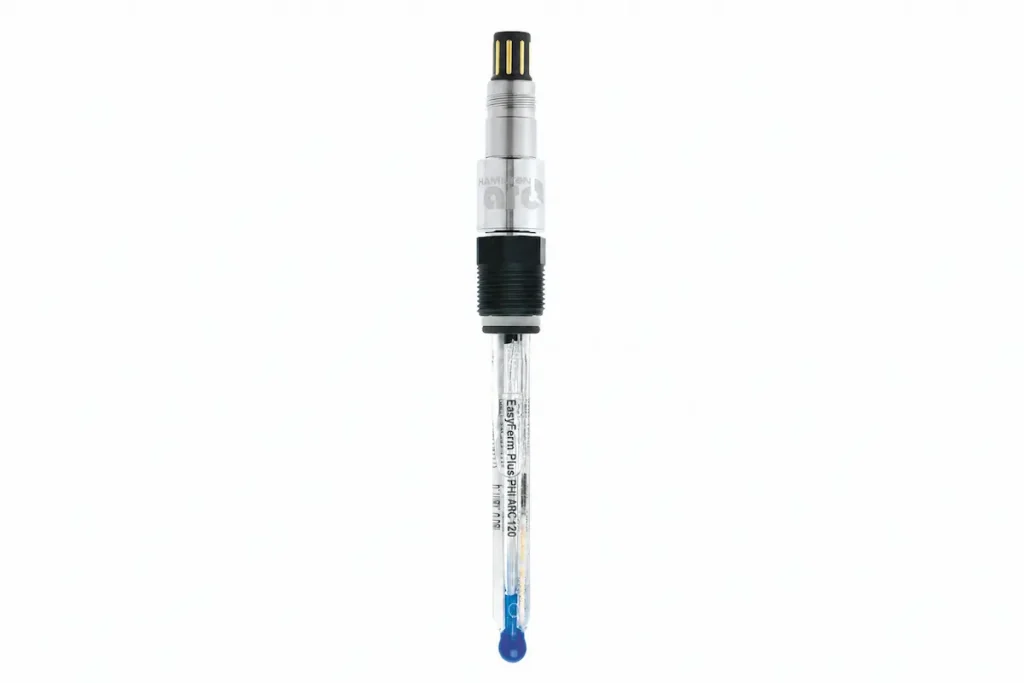
The Hamilton EasyFerm Plus Arc is a Electrochemical pH sensor with the full pH 0–14 measurement range, built on Hamilton’s Arc smart-sensor platform: the transmitter electronics live inside the sensor head, the ModBus output runs directly to the bioprocess controller, and on-board diagnostics report sensor health continuously. Four insertion lengths (120, 225, 325 and 425 mm) cover stirred-tank, BioBench, BioPilot and AppliFlex ST vessels, with autoclave sterilisation to 140 °C, ± 0.02 pH accuracy across the full range, an Ag/AgCl reference system, and validated compatibility with Applikon Livit Flex, ez2-Control, my-Control and in-Control bioprocess controllers.

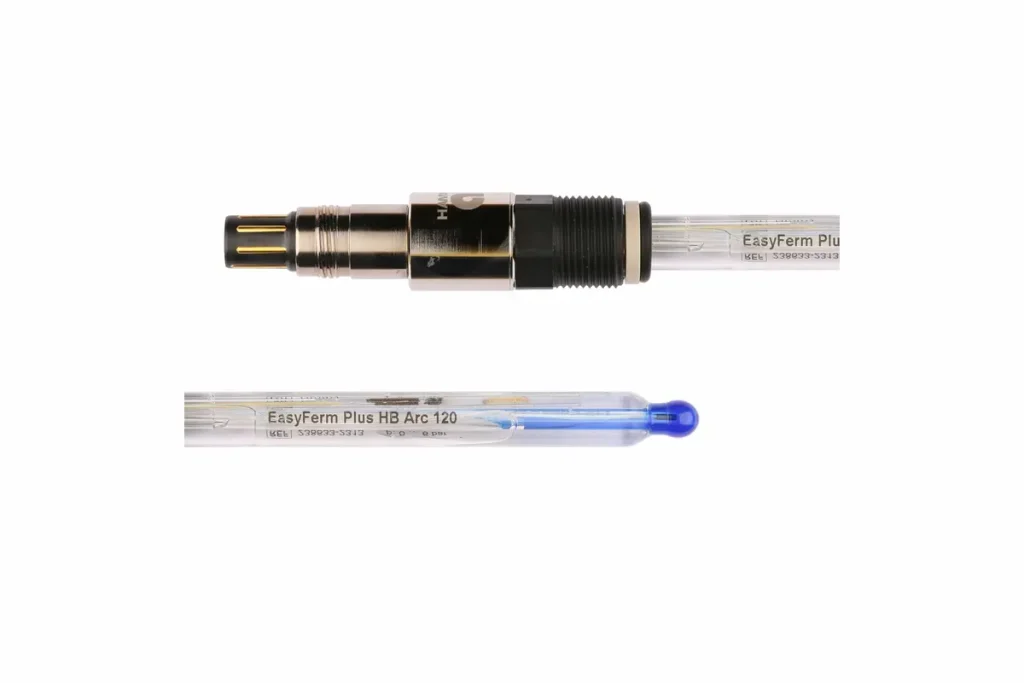
Inside the EasyFerm Plus Arc pH Sensor.

The Hamilton EasyFerm Plus Arc is a pH sensor for processes that work outside the cell-culture band — full pH 0–14 measurement on a smart-sensor platform that talks ModBus directly to your controller. The Arc architecture builds the transmitter into the sensor head itself, so the cable runs straight from the probe to the controller’s digital input; calibration data, sensor diagnostics and temperature compensation all live on the sensor. Whether you’re running an aggressive microbial fermentation, monitoring a CIP cycle in place, or scaling an industrial enzyme process across pilot vessels, the EasyFerm Plus Arc delivers ± 0.02 pH accuracy over the full pH range — with predictive sensor diagnostics that flag service needs before they reach the data.

Hamilton Arc — built-in transmitter, ModBus to controller.

The Hamilton EasyFerm Plus Arc is engineered by Hamilton, a global leader in process analytical sensors with a particularly strong reputation in pH, DO and CO₂ instrumentation for biopharmaceutical, food and life-science applications. The Arc platform — Hamilton’s smart-sensor architecture — integrates the transmitter into the sensor itself, so each probe carries its own electronics, calibration data and diagnostic intelligence. The result is a pH sensor that talks ModBus directly to your controller, with no external transmitter box in between. 

Electrochemical pH measurement across the full 0–14 range.

The EasyFerm Plus Arc measures pH using a combination glass electrode — a pH-sensitive glass membrane develops a voltage proportional to hydrogen-ion activity in the medium, measured against an Ag/AgCl reference system. The Electrochemical principle is the established standard for bioprocess pH measurement, and the EasyFerm Plus configuration is tuned for the full pH 0–14 range, with ± 0.02 pH accuracy maintained across the entire window.

What “full-range” means in practice: most bioprocess pH sensors are tuned for cell culture’s narrow band — the AppliSens Smart pH, for instance, optimises its glass-membrane composition for the pH 2–9 window and delivers tighter ± 0.01 pH accuracy within it. The EasyFerm Plus Arc takes the opposite approach. It accepts a small accuracy concession (± 0.02 pH instead of ± 0.01 pH) in exchange for measuring reliably across the full pH spectrum — including aggressive acid fermentations, base-titrated industrial bioprocesses, and CIP-cycle validation work where the sensor sees pH 1 or pH 13 routinely.

 Four insertion lengths for benchtop through pilot vessels.

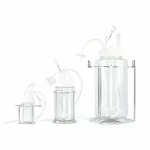
The EasyFerm Plus Arc is available in four insertion lengths covering benchtop through pilot-scale vessels, all using the PG 13.5 standard thread and a consistent 12 mm probe diameter across the range. 

120 mm — small benchtop

  1. 1 AppliFlex ST 500 mL and 2 L (single-use).
  2. 2 Small Glass Autoclavable Bioreactor.

225 mm — standard lab-scale

  1. 1 AppliFlex ST 15 L (single-use).
  2. 2 Standard Glass Autoclavable Bioreactor.

325 mm — bench-scale

  1. 1 BioBench stainless-steel bioreactor.

425 mm — pilot-scale

  1. 1 BioPilot stainless-steel bioreactor.

The 12 mm probe diameter is consistent across the range. The EasyFerm Plus Arc is not currently offered in MiniBio-compatible insertion lengths — the integrated Arc transmitter requires more probe volume than the MiniBio geometry accommodates.

Full-range pH for processes that need it.

The pH 0–14 measurement range isn’t a marketing claim — it’s an engineering choice that broadens what the sensor can actually do. For most mammalian cell culture work, the AppliSens Smart pH’s optimised pH 2–9 range delivers tighter accuracy and is the right tool. But there are bioprocess applications where pH excursions outside that band are routine, not exceptional — microbial fermentation with aggressive acid or base titration where the controller corrects through pH 4 or pH 9 territory during high-OUR phases, industrial enzyme production at extreme pH (some hydrolases work at pH 10+; certain protease processes run at pH 2–3), CIP cycle validation where the sensor stays in the vessel through caustic and acid wash cycles to confirm pH endpoint, and single-cell-protein and biofuel processes where the operating pH falls outside the cell-culture sweet spot.

For these workflows, the EasyFerm Plus Arc covers ranges where a narrower-spec sensor would clip, drift or fail outright. ± 0.02 pH accuracy across the full range is sufficient for closed-loop control on every one of these applications.

The Arc difference — no external transmitter, on-board diagnostics.

The Arc platform puts the transmitter electronics inside the sensor head. That changes the operational picture in two practical ways.
First, no external transmitter box. The cable runs from the sensor directly to the controller’s ModBus input — no signal-conversion module on the bench, no extra rack space, no analog-to-digital conversion error introduced between sensor and controller. On Applikon Livit Flex, ez2-Control, my-Control and in-Control, the sensor is auto-detected by its Arc ID on connection — no manual driver setup.

Second, on-board diagnostics. The sensor monitors its own health — calibration drift, glass-membrane condition, reference-junction status, temperature compensation — and reports continuously to the controller. For long perfusion campaigns or 14-day fermentation runs, this means you know about a drifting calibration or a failing reference junction before it affects the data, not after. For sites with multiple bioreactors, this matters at fleet level: the controller sees sensor health across every vessel, and predictive maintenance becomes a data-driven decision rather than a calendar-based assumption.

WORKFLOW

From port to readings — the EasyFerm Plus Arc workflow

The EasyFerm Plus Arc workflow runs across three phases.

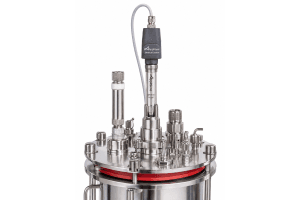
Install. Select the insertion length matching your vessel and seat the sensor through the PG 13.5 port. The VP8 connector mates with the controller’s sensor input; on Applikon Livit Flex, ez2-Control, my-Control and in-Control, the Arc sensor is auto-detected by its Arc ID — no manual driver setup, no firmware configuration.

Calibrate and run. Two-point calibration with standard pH 4.01 and pH 7.00 buffers — with optional three-point extension to pH 9.00 or pH 10.00 for high-pH work — establishes the working slope. The calibration is stored in the sensor’s own non-volatile memory, so the sensor can be moved between vessels without recalibration as long as conditions are equivalent. From there, the sensor reads continuously through autoclave, inoculation and the full run, with ± 0.02 pH accuracy maintained across the process window.

Sterilise and reuse. Autoclave the assembled vessel with the sensor in place, up to 140 °C — a higher rating than even the electrochemical AppliSens sensors. The sensor stays in situ through sterilisation; for CIP/SIP work, it stays in through the cleaning cycles too. The Multi-Use platform supports many cycles, and the Arc diagnostics signal when service is approaching.

What you get with the EasyFerm Plus Arc

  • Full pH 0–14 measurement range — ± 0.02 pH accuracy maintained across the entire spectrum, not just the cell-culture band.
  • Arc smart-sensor architecture — built-in transmitter, on-board calibration storage, real-time diagnostics; no external transmitter box, no analog conversion.
  •  ModBus Arc digital communication — direct integration with Applikon Livit Flex, ez2-Control, my-Control and in-Control; auto-detection on connection.
  • Four insertion lengths, autoclavable to 140 °C — covers AppliFlex ST 500 mL through BioPilot pilot scale; higher sterilisation rating than any electrochemical AppliSens sensor.

Spec your EasyFerm Plus Arc with Resea Biotec

The Hamilton EasyFerm Plus Arc is a full-range pH 0–14 Arc smart sensor — built-in transmitter, on-board calibration storage, on-board diagnostics, ± 0.02 pH accuracy across the full range, autoclavable to 140 °C, and native auto-detection on every Applikon controller in the Resea range. Available in four insertion lengths covering AppliFlex ST single-use bioreactors at 500 mL through to BioPilot pilot-scale stainless-steel vessels.

The choice between the EasyFerm Plus Arc (full range, ± 0.02 pH) and the AppliSens Smart pH (narrower range, ± 0.01 pH) is the conversation worth having before specifying — different processes want different optimisation points, and the call depends on your actual pH operating window. Resea Biotec is the Swiss distribution and service partner for Hamilton bioprocess sensors — based in Recherswil, supporting customers across Switzerland with local technical support and on-site service.

Talk to our team and we’ll spec the right sensor for your process, confirm the right insertion length and thread combination, advise on the calibration buffer workflow for your pH range, and stay on hand for application and maintenance support throughout the sensor’s life. Whether you’re running mammalian cell culture in a tight pH band, microbial fermentation with aggressive titration, industrial bioprocesses at extreme pH, or CIP cycle validation where the sensor stays in through cleaning — we’ll help you spec the right combination end to end.

Contact us
Hamilton EasyFerm Plus Arc
CTA Background

Looking for the Right Bioprocess Solution?

Our specialists support you throughout the entire bioprocess lifecycle — from system selection and application design to implementation, optimization, and long-term operation. We work closely with you to ensure reliable, compliant, and scalable solutions tailored to your requirements.

Talk to Our Experts
Contact Form EN
Request Product

Request Product

Fill out the form and our team will get back to you shortly.

Contact Information