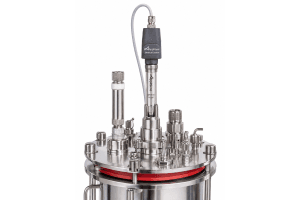
The AppliSens pH+ Bioprocess Sensor in detail.
The AppliSens pH+ is built around a single design decision that defines everything else about its operational profile: a solid sleeve membrane. instead of the porous reference electrodes or open membrane types that dominate the design of classic pH probes. The sleeve membrane physically restricts contact between the culture medium and the reference electrode—eliminating most of the gradual failure modes that aging pH probes exhibit during long bioprocess runs: clogging of the reference electrode by cells and debris, contamination by media components, and the pH drift that operators learn to compensate for before eventually replacing the probe to escape it. With the pH+, the culture medium has less of an impact on the measurement, the reading remains stable for longer, and the sensor itself lasts substantially longer through the long-running cultivation campaigns that increasingly define bioprocess work—extended fed-batch phases, multi-week perfusions, and repeated SIP cycles. The pH range of 4–9 is bioprocess-optimized: deliberately narrower than industrial 0–14 probes, deliberately optimized for the range in which mammalian cell culture and microbial fermentation actually operate.
Experience and quality in every detail.
The pH+ is the bioprocess pH sensor in the AppliSens series—Applikon’s own sensor family, developed in parallel with the Applikon controller portfolio rather than acquired through partnerships. The practical implications are clear: The pH+ connects via native USB integration to Livit Flex, ez2-Control, my-Control, and in-Control , with the AppliSens driver built directly into the Applikon controller software. No external transmitter, no separate transmitter cabinet, no second software stack for learning. Sensor health, calibration history, and live values are all displayed on the same Applikon interface that powers the rest of the bioprocess.
Easy operation with professional process control.
In upstream bioprocessing, pH is not just a process monitoring parameter—it is an active variable that governs cell behavior. Viability depends on remaining within a narrow pH window for most cell lines; drifting out of this window during a fed-batch triggers cascades of apoptosis that no corrective action can fully compensate for. Productivity correlates directly with the tightness of pH control; the difference between a pH ±0.05 control loop and a pH ±0.15 control loop is reflected as percentage points in the titer. Cell stability over long cultivation campaigns depends on pH consistency; pH fluctuations that classical probes fail to detect early on account for a substantial proportion of mammalian batch failures. And downstream drug discovery depends on upstream pH control—protein folding, post-translational modifications, and degradation pathways all shift with pH history. The pH+ is designed so that none of these failure modes can be attributed to the pH probe as a limiting factor.
pH+ compared to the alternatives in the Resea-Biotec catalog.
The Resea Biotec sensor catalogue includes four pH measurement options across two technology families — classical electrochemical pH with AppliSens (Applikon-native) and smart digital pH with on-board electronics or sensor management. The right choice depends on three operational questions: whether native AppliSens integration is the priority (single-vendor calibration workflow, Applikon controller auto-recognition, consolidated service contract), whether smart-sensor data workflows matter (on-board calibration history, predictive replacement signalling, audit-trail-ready diagnostics), and whether the lab already runs a particular third-party sensor ecosystem (Hamilton Arc, Mettler ISM) that the new pH sensor should fit into.
- 1 AppliSens pH+ — Classical electrochemical pH with solid pod membrane — AppliSens (Applikon) — Native Applikon integration with long-cultivation membrane durability and a maintenance profile tuned to extended campaigns.
- 2 AppliSens Smart pH — Smart pH sensor with integrated electronics — AppliSens (Applikon) — Sensor-based data workflows in the AppliSens stack with on-board calibration history.
- 3 Hamilton EasyFerm Plus Arc — pH measurement with Arc Intelligence — Hamilton (third-party provider) — Hamilton-Arc ecosystem labs and multi-vendor sensor environments.
| Cell Type | Cell Culture and Microbial Other Cell Culture Microbial |
| Technology Platform | Multi-Use |
| Insertion lengths in mm | 115 120 135 185 235 325 425 590 |
| Thread Type | M12 PG 13.5 PG 13.5, free spinning |
| Measured Parameter | pH |
| Connector Type | K9 |
| Diameter | 8 mm 12 mm |
| Measurement range | pH 4-9 |
| Measurement Accuracy (±) | ± 0.01 pH |
| Sensors Autoclavable | Yes |
| Sensors Max sterilization temperature | 135 °C |
| Measurement principle | Potentiometry |
| Reference System | Ag / AgCl / KCl sat. |
| Communication type | Analog mV |
| Sensors Compatible bioreactors | Applikon Autoclavable Glass Bioreactor Applikon BioBench Stainless Steel Bioreactor Applikon BioPilot Stainless Steel Bioreactor Applikon MiniBio Bioreactor AppliFlex ST single use-Bioreactors |
| Controller (compatible) | Applikon ez2-Control Bioreactor Controller Applikon in-Control Bioreactor Controller Applikon my-Control Bioreactor Controller |
| PAT-enabled (sensors) | Yes |
Research & Process Development
The AppliSens pH+ delivers PAT-grade pH measurement across the bioprocess-optimised pH 4–9 range with ± 0.01 pH accuracy. The solid-core diaphragm architecture reduces media influence on measurement and lowers susceptibility to fouling — particularly valuable during early-stage media optimisation studies where varied media compositions would compromise classic membrane probes. Eight insertion length options (115–590 mm) match the sensor to vessel geometry from MiniBio screening through to BioPilot pilot scale.
Screening & Optimization
The widest insertion-length range in the AppliSens sensor catalogue — 115, 120, 135, 185, 235, 325, 425 and 590 mm — lets the same sensor architecture move between MiniBio screening, Applikon Autoclavable Glass Bioreactor lab-scale, AppliFlex ST single-use, BioBench stainless-steel and BioPilot pilot vessels without changing sensor SKUs. The solid-core diaphragm’s long-cultivation durability eliminates mid-screening pH probe replacements that compromise screening run continuity.
GMP Transition
Built for the transition from research workflows into regulated process development. Autoclavable to 135 °C, SIP and CIP tolerant, with native AppliSens controller integration through the standard K9 analog input on Applikon Livit Flex, ez2-Control, my-Control and in-Control. The sensor inherits the same validation chain and audit-trail architecture as the rest of the AppliSens stack — no parallel sensor-management software, no separate validation lineage.
GMP Manufacturing
Suitable for cGMP-compliant bioprocess production from pilot through full-scale manufacturing. The Ag/AgCl/KCl-saturated reference electrode system is the proven electrochemical pH measurement standard for regulated bioprocess production, with full Applikon controller integration and Lucullus PIMS data flow.
Compatible Bioreactors
- Applikon MiniBio Bioreactor The Applikon MiniBio is a small glass autoclavable stirred-tank bioreactor, smal…
- Applikon Autoclavable Glass Bioreactor The Applikon Autoclavable Glass Bioreactor is a stirred tank bioreactor designed…
- Applikon BioBench Stainless Steel Bioreactor The Applikon BioBench is a stainless steel bioreactor system designed for simple…
- Applikon BioPilot Stainless Steel Bioreactor The Applikon BioPilot is a stainless steel bioreactor system for simple and reli…
- AppliFlex ST Single-Use Bioreactor The Applikon AppliFlex ST is a fully customizable single-use stirred tank biorea…
Compatible controllers
- Applikon Livit Flex Bioprocess Controller The Applikon Livit Flex is the next generation of bioprocess control systems — c…
- Applikon ez2-Control Bioreactor Controller The Applikon ez2-Control is an advanced bioreactor controller designed to simpli…
- Applikon my-Control Bioreactor Controller The Applikon my-Control is the most advanced bioreactor controller for small-sca…
- Applikon in-Control Bioreactor Controller The Applikon in-Control is a process controller for laboratory scale bioreactors…
Compatible sensors
Compatible software
Mammalian Cells
Mammalian cells have become the linchpin in the production of recombinant glycoproteins such as hormones, enzymes, cytokines, and antibodies, all of which play pivotal roles in human therapy.
Learn MoreStem Cells
Stem cells represent a pioneering achievement in biomedical research and therapy, offering unprecedented opportunities for regenerative medicine, including tissue engineering and the treatment of various diseases.
Learn MoreMicrobials
In the field of industrial microbiology, the cultivation of microorganisms through bioreactor fermentation stands as a cornerstone technique for producing a broad spectrum of microbial products, from antibiotics, biofuels to food and beverages
Learn MorePlant Cells and Algae
At the forefront of sustainable biotechnology, the cultivation of plant cells and algae within bioreactors presents a revolutionary approach to producing valuable biochemicals, pharmaceuticals, and biofuels
Learn MoreInsect Cells
In the rapidly evolving landscape of biotechnology, the Baculovirus Expression Vector System (BEVS) with insect cells stands out as a versatile and powerful tool for protein production.
Learn More
Cellular Agriculture
Cellular agriculture represents a groundbreaking shift in food production, centering around the concept of cellular food solutions. This innovative field harnesses biotechnology to cultivate animal and plant cells for food, directly in a controlled environment, bypassing traditional farming methods.
Learn MoreBiotherapeutics
Discover biologicals, where innovation meets healthcare to revolutionize treatment methodologies and patient care. Biotherapeutics include a broad range of biologically derived products, such as monoclonal antibodies (mABs), viral vectors, and vaccines, each playing a pivotal role in targeted disease treatment and prevention.
Learn MoreCell and Gene Therapy
Cell and gene therapy is revolutionizing modern medicine. For the safe development and manufacturing of these therapies, Resea Biotec bioreactors provide the ideal controlled environment, guaranteeing precision, scalability, and efficiency in the production process.
Learn More
Why membrane geometry is the whole story.
In a conventional pH electrode, the reference electrode is exposed to the culture medium via a porous frit or open membrane. This geometry functions adequately in clean buffers—but in a running bioreactor, where cells, proteins, lipids, and media particles are constantly in contact with the reference electrode, creeping contamination is the dominant failure mode for pH probes. Cells clog the porous structure; proteins adsorb to the membrane surface; reference electrolyte leaks out faster than the buffer inside can equilibrate. The measurement drifts, the operator compensates, and eventually the probe is replaced. The solid sleeve membrane changes this geometry. Instead of an exposed porous reference electrode, a physical sleeve confines the medium-reference electrode interaction to a controlled flow path—substantially reducing the rate at which biomass, proteins, and media components can foul the reference electrode. The probe remains accurate for longer, the calibration interval is extended, and the sensor lifespan over repeated cultivation cycles measurably increases. For the buyer evaluating pH probe options, the membrane geometry is the design decision that most significantly impacts the operational outcome.

The maintenance and calibration profile that fits into the AppliSens stack.
The AppliSens pH+ is designed for easy calibration and fast response time —the two operator-side metrics that matter most in a busy lab. With native USB integration, the calibration workflow runs through the Applikon controller interface instead of separate sensor management software. The calibration history migrates with the sensor configuration; the controller logs every calibration event for audit trail purposes. The response time is fast enough to allow pH control loops to operate with the tight setpoint windows required by mammalian cell culture. Low fouling sensitivity. means the calibration interval is determined by the culture chemistry, not the probe design—defining a true AppliSens stack workflow. For organizations that standardize on AppliSens in their sensor portfolio, the pH+ behaves just like the LumiSens, the DO₂ probes and the RedOx probe: native integration, predictable maintenance, no surprises in the validation package.

From port to pH readings — the AppliSens pH+ workflow.
The AppliSens pH+ workflow runs across three phases.
Install. Connect the AppliSens pH+ to your Applikon controller via USB — the AppliSens driver is integrated into Livit Flex, ez2-Control, my-Control and in-Control, so the sensor is recognised on connection with no separate driver installation, no firmware mapping. Install through your bioreactor’s sensor port and autoclave the assembled vessel with the sensor in place where the campaign requires it.
Calibrate. Standard two-point calibration through the controller interface establishes the working pH signal across the 4–9 bioprocess range. The fixed sleeve membrane architecture delivers a stable calibration baseline that holds across long campaigns — the sensor’s substantially extended lifespan vs. classic membrane pH probes means calibration is required less frequently and drifts less between calibration cycles.
Operate. Real-time pH data appears on the Applikon controller interface throughout the campaign — pH control loops run against the specified setpoints; calibration history and sensor diagnostics display on the same user interface that manages dosing, temperature, stirring and feeding. Pass the pH data to Lucullus PIMS or OPC UA-connected SCADA for the data management layer.
Why use the AppliSens pH+?
- Bioprocess pH 4–9 measurement range — tailored to cell culture, microbial fermentation, mammalian, stem-cell and yeast cultivation workflows where the operating pH stays inside the bioprocess band.
- Fixed sleeve membrane architecture — reduces media influence on measurement, lowers susceptibility to fouling, delivers a stable signal over long periods and substantially extends sensor lifespan vs. classic membrane pH probes.
- Improved accuracy and faster response — measurement accuracy improvement over classic membrane probes with short response time and simple calibration workflow.
- Native Applikon integration — USB connection with the AppliSens driver built into Livit Flex, ez2-Control, my-Control and in-Control; auto-recognition on connection, no external transmitter, no separate sensor management software.
- AppliSens-native sensor bench — designed to integrate alongside AppliSens LumiSens (optical DO₂), AppliSens DO and AppliSens RedOx for a single-vendor calibration workflow and consolidated AppliSens service contract.
- Lab-to-production scale span — process development from sub-100 mL screening through to multi-litre production work, on the same sensor architecture across the scale range.
The pH sensor that fits into the AppliSens stack.
The AppliSens pH+ is the pH sensor most labs choose when long cultivation campaigns and native AppliSens integration are both important. The solid-core diaphragm delivers the operational longevity that traditional pH probes lose with use, the bioprocess-optimised pH 4–9 range matches the operating window of cell culture, microbial fermentation, mammalian, stem-cell and yeast workflows, and the AppliSens architecture eliminates the integration overhead that multi-vendor sensor deployments carry. Native USB integration with Applikon Livit Flex, ez2-Control, my-Control and in-Control — and designed to sit alongside AppliSens LumiSens (optical DO₂) on the same controller, the same calibration workflow, the same service contract.
A pH sensor change is rarely just a sensor change — it lands inside an existing controller stack, an existing calibration cadence and an existing service contract, and the integration work is what determines whether the upgrade actually delivers. The AppliSens pH+ fits inside the AppliSens stack rather than asking the lab to add a parallel one. Resea Biotec is Switzerland’s official Applikon distributor and certified service partner — based in Recherswil, supporting customers across Switzerland with local stock, German-language technical support and on-site service.
Talk to our team and we’ll spec the right AppliSens pH+ configuration for your bioreactor, plan the AppliSens driver activation across your existing controller fleet, advise on the calibration buffer workflow for your campaign profile, and stay on hand for application and maintenance support throughout the sensor’s life. Whether you’re extending a long mammalian cell culture campaign that has outlived its previous pH probe service interval, building out an AppliSens-native sensor bench with pH + LumiSens optical DO₂, or transitioning a fermentation process where membrane fouling is a recurring service event — we’ll help you spec the right combination end to end.

AppliSens pH+ datasheet & technical resources
Product specifications, solid-core diaphragm architecture, autoclave and SIP/CIP tolerance, and full integration reference for the AppliSens pH+ pH sensor — alongside the complete AppliSens sensor family (LumiSens, smart pH, smart DO₂, DO).
AppliSens Sensors — Manufacturer’s bioprocess sensor catalogue.
The complete AppliSens bioprocess sensor catalogue from the manufacturer — covering the AppliSens LumiSens optical DO₂ (RedFlash technology, 8 mm probe, 115/135/185 mm lengths), AppliSens smart pH sensors (VP8 connector, integrated pt1000 temperature sensor, 12 mm diameter, 235/325/425/590 mm lengths), AppliSens pH+ sensors (fixed sleeve diaphragm, pH 4–9 range, tempered glass shaft, 115/120/135/185/235/325/425/590 mm lengths), AppliSens smart DO₂ sensors (Livit Link transmitter), and AppliSens DO₂ sensors (titanium membrane module, autoclavable polarisation). Includes measurement principles, full specifications, materials of construction, and pressure/temperature/cGMP compatibility data for each sensor.