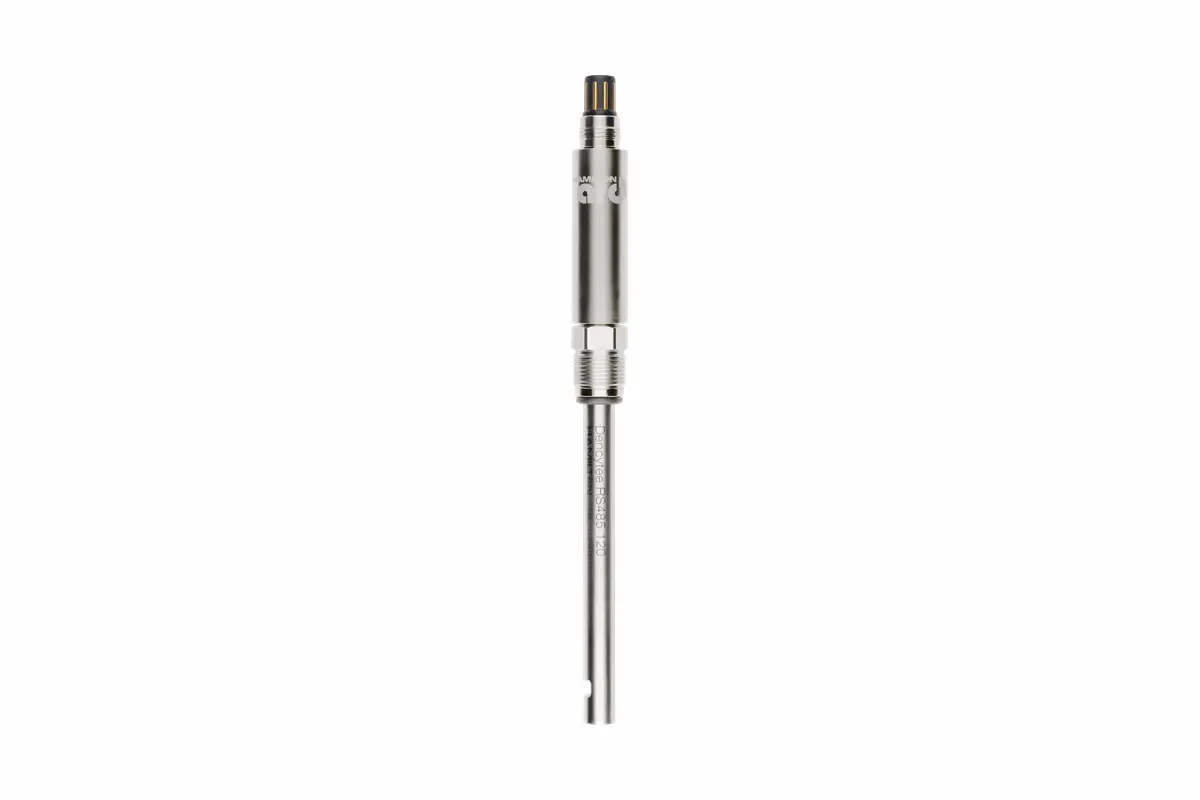
The Hamilton Dencytee Arc Cell Density Sensor in detail.
The Dencytee Arc is a real-time sensor for total cell density and turbidity, built on the measurement of near-infrared transflectance. . A NIR light source emits into the suspension; the suspension scatters and reflects a fraction of this light back onto a detector built into the same sensor head. The amount of light that returns is a direct function of the biomass—the total biomass of every particle in the suspension—present in front of the optical window. No sampling, no offline analysis, no delay between cultivation event and measurement. The signal covers 0–200 g/L (dry cell mass, yeast reference) with an accuracy of ±0.1%—a range wide enough to track microbial fermentation from inoculation to high-density harvest, yet dense enough to capture the small density inflections that mark media changes and feeding strategy responses.
Experience and quality in every detail.
The Dencytee Arc belongs to Hamilton’s Arc sensor family —the platform whose defining engineering decision is to integrate the transmitter into the sensor head. Microprocessor, calibration data, and signal conditioning are all housed within the Dencytee Arc itself; the sensor communicates directly with the Applikon controller via Modbus ARC —no external transmitter, no signal converter box, no separate control cabinet. In practice: activate the Hamilton Arc driver in your Applikon controller, connect the Dencytee Arc, and configuration, calibration, and live data appear via the familiar Applikon interface. Livit Flex, ez2-Control, my-Control, and in-Control natively support full Arc integration.
Easy operation with professional process control.
The Dencytee Arc and its sister sensor, the Hamilton Incyte Arc , cover two complementary cell density measurement modes that together address any cultivation chemistry. The Dencytee Arc measures total cell density via NIR optical transflectance—every particle in the suspension contributes to the signal, including live cells, dead cells, aggregates, and debris. This is the right measure for fermentation processes where total biomass is the operative variable, where cells are dense enough to flood a capacitive signal, or where the process goal is media optimization versus gross biomass output. The Incyte Arc, on the other hand, measures live cell density via capacitive measurement—only cells with intact membranes contribute. This is the right measure for cell culture, especially mammalian and stem cell workflows, where the live cell count is more important than total biomass. Many bioprocess organizations install both on the same controller — for the same reason a process operator wants to have both blood pressure and heart rate.
Choose your Dencytee Arc insertion length.
The Dencytee Arc is supplied in four insertion lengths covering every Applikon vessel format — and shares the same 12 mm diameter, PG 13.5 thread, VP8 connector and 140 °C autoclave rating across the entire range.
120 mm — small R&D.
- 1 BioPilot stainless-steel bioreactor — pilot production and scale-up studies.
225 mm — standard lab-scale.
- 1 2 L & 3 L Standard Glass Autoclavable Bioreactor — process development on laboratory scale.
- 2 2L & 3L AppliFlex ST single-use bioreactor — closed single-use integration.
325 mm — 7 L lab-scale
- 1 7 L Standard Glass Autoclavable Bioreactor — process development on laboratory scale.
425 mm — 15 L and 20 L lab-scale
-
1
15 L & 20 L Standard Glass Autoclavable Bioreactor — process development on laboratory scale. - 2 15L AppliFlex ST single-use bioreactor — closed single-use integration.
The 12 mm probe diameter is consistent across the range. Like the Incyte Arc, the Dencytee Arc is offered in a length of 120 mm – 425 mm — total cell density monitoring becomes available at the smallest screening scale, particularly valuable during early growth phases when cell concentrations are still too low for capacitance-based VCD measurement to read reliably.
Technical Features of the Hamilton Dencytee ARC
The Dencytee ARC is an intelligent NIR optical sensor engineered for reliable real-time total cell density measurement in bioprocesses. Below you will find the full technical specifications, compliance details and system configurations available for the Dencytee ARC.
| Cell Type | Cell Culture and Microbial Cell Culture Microbial |
| Technology Platform | Multi-Use |
| Insertion lengths in mm | 120 225 325 425 |
| Thread Type | PG 13.5 |
| Measured Parameter | Total Cell Density (TCD) / Turbidity |
| Connector Type | VP8 |
| Diameter | 12 mm |
| Measurement range | 0–4 AU 0–200 g/L (cell dry weight, yeast) 0–30'000 NTU |
| Measurement Accuracy (±) | ±1 % |
| Sensors Autoclavable | Yes |
| Sensors Max sterilization temperature | 140 °C |
| Measurement principle | Optical transflectance (NIR) |
| Reference System | Combined transmission + reflection reference |
| Communication type | ModBus ARC |
| Sensors Compatible bioreactors | Applikon Autoclavable Glass Bioreactor Applikon BioBench Stainless Steel Bioreactor Applikon BioPilot Stainless Steel Bioreactor AppliFlex ST single use-Bioreactors |
| Controller (compatible) | Applikon ez2-Control Bioreactor Controller Applikon in-Control Bioreactor Controller Applikon Livit Flex Bioprocess Controller Applikon my-Control Bioreactor Controller |
| PAT-enabled (sensors) | Yes |
Research & Process Development
The Dencytee ARC delivers real-time, non-invasive total cell density and turbidity measurement throughout the entire cultivation run — across both cell culture and microbial applications. With a microprocessor built directly into the sensor, it communicates via Modbus ARC protocol straight to any compatible Applikon controller — no external transmitter, no additional hardware, no extra calibration steps. Simply insert into a standard PG 13.5 bioreactor port, activate the Hamilton ARC driver, and real-time total cell density data is available immediately in your familiar controller interface.
Screening & Optimization
Continuous, non-invasive cell density monitoring across a measurement range of 0–200 g/L at ±0.1% accuracy gives researchers the data quality needed to evaluate and optimize media formulations, feeding strategies, and cultivation conditions without disturbing the culture or requiring sampling. Compatible with glass autoclavable bioreactors, AppliFlex ST single-use systems, BioBench, and BioPilot — the Dencytee ARC integrates into screening setups at any scale without additional adapters.
GMP Transition
The Dencytee ARC is fully PAT-enabled and autoclavable at up to 140°C — making it suitable for use in both glass and stainless steel regulated environments. Its transmitter-free architecture reduces complexity and potential failure points, simplifying the validation and qualification process when transitioning a process into a GMP-compliant environment. Direct integration with the Applikon Livit Flex, ez2-Control, my-Control, and in-Control platforms ensures seamless compatibility with any existing validated control infrastructure.
Compatible controllers
- Applikon Livit Flex Bioprocess Controller The Applikon Livit Flex is the next generation of bioprocess control systems — c…
- Applikon ez2-Control Bioreactor Controller The Applikon ez2-Control is an advanced bioreactor controller designed to simpli…
- Applikon my-Control Bioreactor Controller The Applikon my-Control is the most advanced bioreactor controller for small-sca…
- Applikon in-Control Bioreactor Controller The Applikon in-Control is a process controller for laboratory scale bioreactors…
Compatible bioreactors
- Applikon MiniBio Bioreactor The Applikon MiniBio is a small glass autoclavable stirred-tank bioreactor, smal…
- Applikon Autoclavable Glass Bioreactor The Applikon Autoclavable Glass Bioreactor is a stirred tank bioreactor designed…
- Applikon BioBench Stainless Steel Bioreactor The Applikon BioBench is a stainless steel bioreactor system designed for simple…
- Applikon BioPilot Stainless Steel Bioreactor The Applikon BioPilot is a stainless steel bioreactor system for simple and reli…
- AppliFlex ST Single-Use Bioreactor The Applikon AppliFlex ST is a fully customizable single-use stirred tank biorea…
Compatible software
-
Mammalian Cells
Mammalian cells have become the linchpin in the production of recombinant glycoproteins such as hormones, enzymes, cytokines, and antibodies, all of which play pivotal roles in human therapy.
Learn More -
Stem Cells
Stem cells represent a pioneering achievement in biomedical research and therapy, offering unprecedented opportunities for regenerative medicine, including tissue engineering and the treatment of various diseases.
Learn More -
Microbials
In the field of industrial microbiology, the cultivation of microorganisms through bioreactor fermentation stands as a cornerstone technique for producing a broad spectrum of microbial products, from antibiotics, biofuels to food and beverages
Learn More -
Plant Cells and Algae
At the forefront of sustainable biotechnology, the cultivation of plant cells and algae within bioreactors presents a revolutionary approach to producing valuable biochemicals, pharmaceuticals, and biofuels
Learn More -
Insect Cells
In the rapidly evolving landscape of biotechnology, the Baculovirus Expression Vector System (BEVS) with insect cells stands out as a versatile and powerful tool for protein production.
Learn More
-
Cellular Agriculture
Cellular agriculture represents a groundbreaking shift in food production, centering around the concept of cellular food solutions. This innovative field harnesses biotechnology to cultivate animal and plant cells for food, directly in a controlled environment, bypassing traditional farming methods.
Learn More -
Biotherapeutics
Discover biologicals, where innovation meets healthcare to revolutionize treatment methodologies and patient care. Biotherapeutics include a broad range of biologically derived products, such as monoclonal antibodies (mABs), viral vectors, and vaccines, each playing a pivotal role in targeted disease treatment and prevention.
Learn More -
Cell and Gene Therapy
Cell and gene therapy is revolutionizing modern medicine. For the safe development and manufacturing of these therapies, Resea Biotec bioreactors provide the ideal controlled environment, guaranteeing precision, scalability, and efficiency in the production process.
Learn More
How NIR optical transflectance actually works
A bioreactor in active cultivation is optically a turbid suspension. When light is shone into it, a fraction is scattered by particles — cells, aggregates, debris — and a fraction returns to the source. Transflectance is the technique that uses both directions simultaneously: the Dencytee Arc emits a near-infrared (NIR) beam from the sensor head, and the same head detects the light backscattered by the suspension. NIR is the operationally crucial choice — it lies within a wavelength window where culture media, solutes and most pigments are essentially transparent, but suspended biomass scatters strongly. The result is a measurement that responds proportionally to the volume fraction of biomass — not to media chemistry, dissolved nutrients or colour shifts during the run.
The practical consequence shows up where most cell density measurement methods struggle. At low cell concentrations — the lag phase, early growth, immediately after inoculation — capacitance-based VCD sensors don’t yet have enough viable signal to read reliably; the Dencytee Arc’s optical signal-to-noise reads cleanly here, so the growth curve is visible from the first hours. At high cell concentrations — late log, microbial fermentation at production density — the combined transmission-plus-reflection architecture across the 5 mm sensing gap maintains linearity where single-detector turbidity sensors saturate; the curve stays accurate through the harvest decision. And across media composition changes — feed-batch transitions, base addition, glucose pulses — the NIR wavelength window keeps the measurement on biomass rather than on whatever the media is doing optically. One sensor across the full growth curve, on media that don’t have to be transparent.
Real-time cell density — no transmitter required
Traditional cell density measurement relied on an external transmitter between the sensor and the control system — which entailed hardware, signal-path complexity, calibration steps and validation effort. Hamilton’s Arc technology eliminates this layer entirely. With the transmitter directly in the Dencytee Arc sensor head, the sensor communicates straight to the Applikon controller over Modbus Arc, and real-time total cell density data appears in the same interface that drives the rest of the bioprocess.
The architecture changes the picture once you have more than one sensor on the bench. Calibration history travels with each Dencytee Arc through every vessel transfer — so a sensor moved from a screening run on Applikon Autoclavable Glass Bioreactor into a pilot run on BioPilot carries its calibration record forward without manual logbook reconciliation. Across a multi-bioreactor pilot platform, ArcAir — Hamilton’s sensor management software — reads the on-board records from every Dencytee Arc plus every paired Incyte Arc plus every other Hamilton Arc sensor in the lab, presenting calibration status, sensor health, predicted service intervals and audit-trail-ready run history on one dashboard. Sensor swaps stop being validation events and become routine operations: the architecture that removes the transmitter box also removes most of the documentation friction around running a Hamilton Arc fleet.
From port to growth curve — using the Dencytee Arc
The Dencytee Arc workflow runs across three phases.
Install. Enable the Hamilton Arc driver in your Applikon controller — Livit Flex, ez2-Control, my-Control or in-Control — and select the insertion length matching your vessel (120 mm for MiniBio and compact Applikon Autoclavable Glass Bioreactor, 225 mm for standard Applikon Autoclavable Glass Bioreactor and benchtop systems, 325 mm for BioBench and AppliFlex ST, 425 mm for BioPilot). Install through the standard PG 13.5 sensor port using the VP8 connector. The controller auto-detects the sensor on connection.
Calibrate. Two-point calibration against your media establishes the working turbidity signal across the 0–200 g/L cell dry matter range (yeast reference). Calibration is stored in the sensor’s on-board memory, so the Dencytee Arc can be moved between vessels of the same type without recalibration. Calibration history flows back into ArcAir — Hamilton’s sensor management software — for fleet-wide review and audit-trail logging.
Operate. Autoclave the sensor in situ at up to 140 °C — the integrated Arc electronics are designed for repeated SIP cycles. Once cultivation starts, the sensor measures total cell density continuously via NIR transflectance at 860 nm — combining transmission and reflection signals across a 5 mm sensing gap for reliable measurement at both low and high cell concentrations. Pass the TCD signal to Lucullus PIMS environment for the data management layer.
Why use the Dencytee ARC?
- Reliable across the full growth curve — NIR transflectance measurement (transmission + reflection at 860 nm) reads accurately at both low concentrations during lag and early growth phases, where capacitance-based VCD methods become unreliable, and at high cell densities during late-log growth.
- Real-time total cell density — continuous measurement across 0–200 g/L (cell dry matter, yeast reference), with ± 0.1 % accuracy.
- Arc Intelligence on board — integrated microprocessor replaces the external transmitter, with calibration history and configuration data stored in the sensor itself and migrating with it between vessels.
- ArcAir sensor management — fleet-wide calibration history, sensor health monitoring and audit-trail-ready diagnostics.
- Across the full Applikon vessel range — four insertion lengths (120 / 225 / 325 / 425 mm) covering MiniBio through to BioPilot pilot scale, with PG 13.5 thread and 12 mm diameter consistent across the range.
- Pairs with the Incyte Arc for total + viable cell density — same probe form factor, same controller integration, same ArcAir workflow; the two sensors together cover the full growth curve from lag-phase TCD through to harvest-timing VCD.
Generate more data from your bioprocess
The Hamilton Dencytee Arc is the total cell density sensor most fermentation labs choose when offline OD sampling becomes a bottleneck. NIR transflectance measurement at 860 nm reads accurately across the full growth curve — from lag-phase low concentrations where capacitance VCD methods don’t yet have signal, through to high-density late-log production where single-detector turbidity sensors saturate. Arc Intelligence places the transmitter inside the sensor body, with calibration history stored on-board and ArcAir diagnostics across the fleet. Available in four insertion lengths (120 / 225 / 325 / 425 mm) covering Applikon MiniBio at small-scale screening through to BioPilot at pilot scale, with native integration on every Applikon controller in the Resea range.
A cell density sensor rarely changes a process on its own — it changes the workflow around it. Real-time TCD turns feeding strategies from sampling-based inferences into closed-loop control, harvest timing from offline-counting infrastructure into a single threshold-cross event, and bench operator time from sampling-and-analysis cycles into actual process supervision. Paired with the Hamilton Incyte Arc for viable cell density, the two sensors together cover the full growth curve from lag-phase TCD through to harvest-timing VCD on the same controller architecture and the same ArcAir workflow. Resea Biotec is the Swiss distribution and service partner for Hamilton bioprocess sensors — based in Recherswil, supporting customers across Switzerland with local technical support and on-site service.
Talk to our team and we’ll spec the right Dencytee Arc insertion length for your vessel, plan the Arc driver activation across your existing controller fleet, coordinate ArcAir deployment and sensor-management workflow setup, and stay on hand for application advice and maintenance support throughout the sensor’s life. Whether you’re running a high-density yeast fermentation, characterising a new media composition, building out a paired Incyte + Dencytee Arc PAT setup across a pilot platform, or transitioning a process to GMP compliance — we’ll help you spec the right combination end to end.
Dencytee Arc datasheet & technical resources
Product specifications, NIR transflectance measurement principle, ArcAir integration and process applications for the Hamilton Dencytee Arc total cell density sensor — alongside the complementary Incyte Arc viable cell density sensor.
Hamilton Dencytee Arc & Incyte Arc — Cell density sensor brochure.
Hamilton’s combined product brochure for the Dencytee Arc (total cell density, NIR transflectance at 860 nm) and Incyte Arc (viable cell density, capacitance-based) cell density sensors. It explains the measurement principles, applications in mammalian cell culture, fermentation, perfusion, and cultivated meat, plus the ArcAir® software integration and process connectivity (Profibus, OPC UA, 4-20 mA, Profinet, Modbus, Foundation Fieldbus).