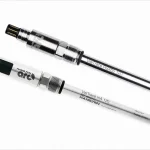
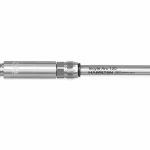
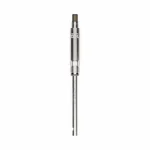
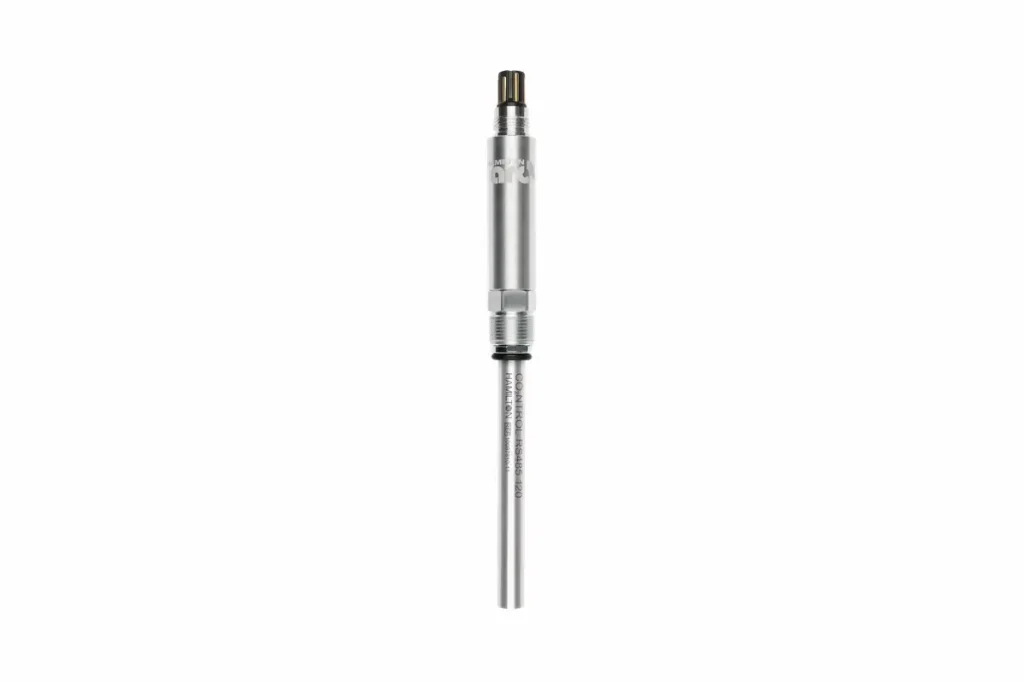
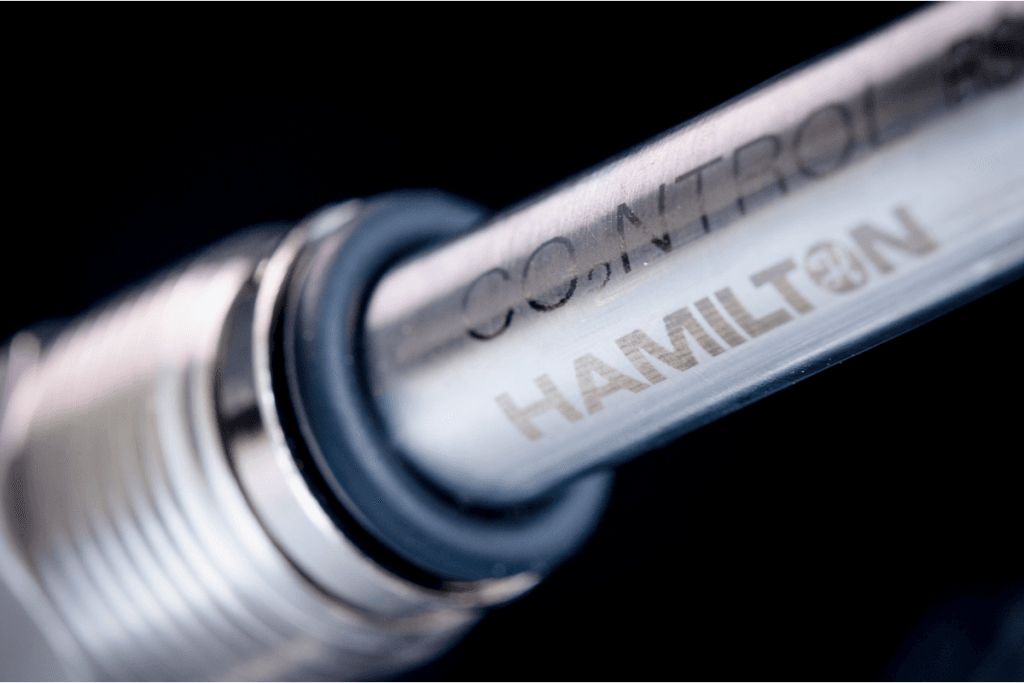
A closer look at the Hamilton CO₂NTROL Arc Sensor.
The Hamilton CO₂NTROL Arc Sensor brings non-dispersive infrared CO₂ measurement directly into the bioreactor — and bundles the entire signal chain into the sensor head. The Arc smart-sensor architecture means the transmitter electronics, calibration data and sensor diagnostics all live on the probe itself; the cable simply carries ModBus to the controller. For cell culture and microbial fermentation alike, that translates to a single connection, a single point of calibration, and a continuous direct read of dissolved CO₂ — no equilibrator, no off-gas inference, no sampling delay.
Hamilton — the digital Arc sensor platform.
The Hamilton CO₂NTROL Arc Sensor is engineered by Hamilton, a global leader in process analytical sensors with a particularly strong reputation in pH, DO and CO₂ instrumentation for biopharmaceutical, food and life-science applications. The Arc platform — Hamilton’s flagship smart-sensor architecture — integrates the transmitter into the sensor itself, so each probe carries its own electronics, calibration data and diagnostic intelligence. The result is a sensor that talks ModBus directly to your controller, with no external transmitter box in between.
NDIR optics for direct CO₂ measurement.
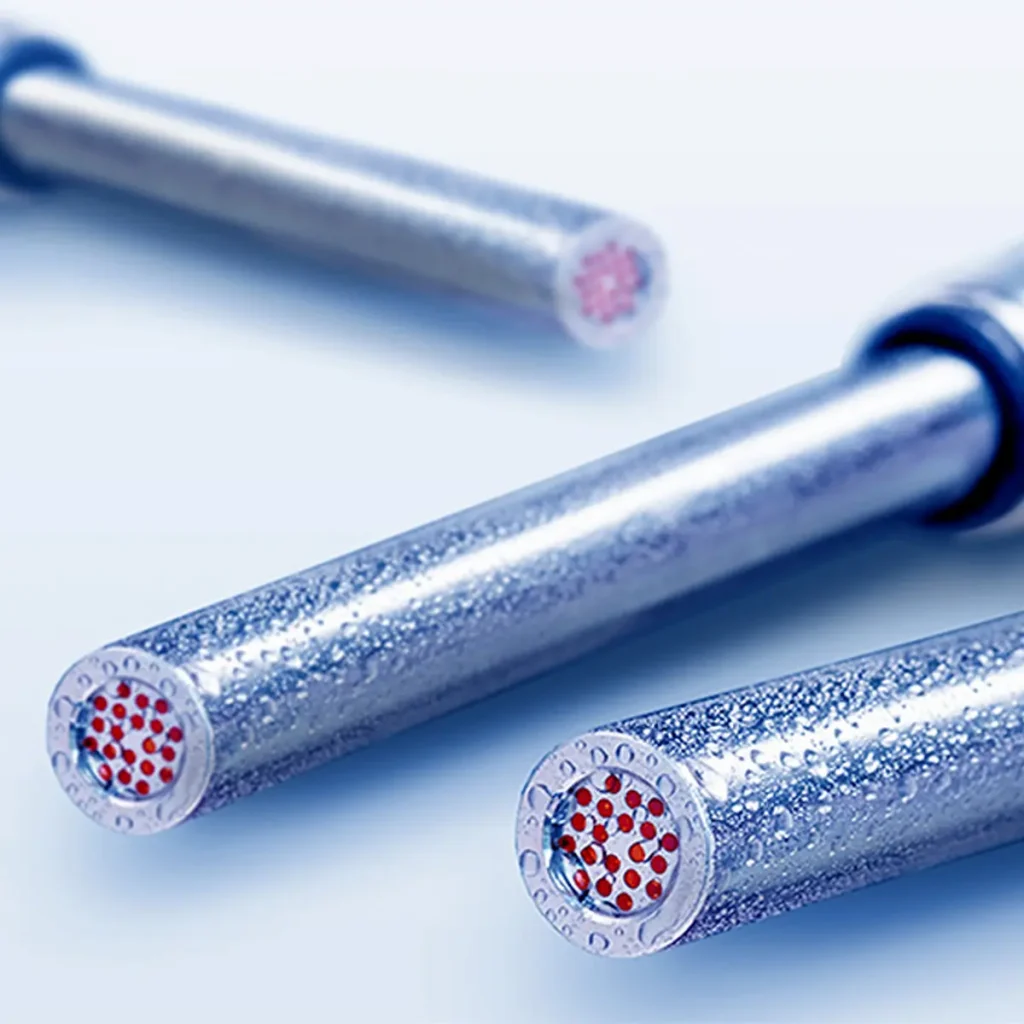
The Hamilton CO₂NTROL Arc Sensor measures dissolved CO₂ using non-dispersive infrared (NDIR) spectroscopy. CO₂ in the bioreactor medium equilibrates across a gas-permeable membrane into the sensor’s internal measurement cavity, where it absorbs a specific infrared wavelength; the absorption is measured against an internal solid-state reference, and the result is converted directly into dissolved CO₂ concentration in mg/L, %-vol or mbar units. The measurement range spans 5–1000 mbar (or 7.5–1500 mg/L at 101.3 kPa, 25 °C), with ± 5 mbar accuracy in the 5–100 mbar window and 5 % accuracy above 100 mbar — the bioprocess-relevant ranges.
Because NDIR is an optical method, the measurement is inherently drift-low and doesn’t depend on electrolyte chemistry. There’s no reference electrolyte to refresh, no membrane chemistry to replace as a planned maintenance step — the sensor’s service profile looks different from anything electrochemical.
Five insertion lengths from benchtop to pilot scale.
The CO₂NTROL Arc is available in five insertion lengths covering every Applikon vessel format from benchtop through pilot scale — and shares the same 12 mm diameter, PG 13.5 thread, VP8 connector and standardised port across the entire range.
120 mm — small benchtop.
- 1 AppliFlex ST 500 mL and 2 L (single-use).
- 2 Small Glass Autoclavable Bioreactor.
160 mm — mid-range benchtop.
- 1 AppliFlex ST 3 L (single-use).
- 2 Mid-range Glass Autoclavable benchtop vessels.
225 mm — standard lab-scale.
- 1 AppliFlex ST 15 L (single-use).
- 2 Standard Glass Autoclavable Bioreactor.
325 mm — bench-scale.
- 1 BioBench stainless-steel bioreactor.
425 mm — pilot-scale.
- 1 BioPilot pilot-scale stainless-steel bioreactor.
The 12 mm probe diameter is consistent across the range — every length installs through the same standardised port. The CO₂NTROL Arc is not currently offered in MiniBio-compatible insertion lengths; the integrated Arc transmitter requires more probe volume than the MiniBio geometry accommodates.
| Cell Type | Cell Culture and Microbial Cell Culture Microbial |
| Technology Platform | Multi-Use |
| Insertion lengths in mm | 120 160 225 325 425 |
| Thread Type | PG 13.5 |
| Measured Parameter | Dissolved CO₂ |
| Connector Type | VP8 |
| Diameter | 12 mm |
| Measurement range | 0.5–100 %-vol 5–1000 mbar 7.5–1500 mg/L (at 101.3 kPa, 25 °C) |
| Measurement Accuracy (±) | 5 % (>100 mbar) ± 5 mbar (5–100 mbar) |
| Sensors Autoclavable | Yes |
| Sensors Max sterilization temperature | 130 °C |
| Measurement principle | Non-Dispersive Infrared (NDIR) |
| Reference System | Internal solid-state reference |
| Communication type | ModBus ARC |
| Sensors Compatible bioreactors | Applikon Autoclavable Glass Bioreactor Applikon BioBench Stainless Steel Bioreactor Applikon BioPilot Stainless Steel Bioreactor AppliFlex ST single use-Bioreactors |
| Controller (compatible) | Applikon ez2-Control Bioreactor Controller Applikon in-Control Bioreactor Controller Applikon Livit Flex Bioprocess Controller Applikon my-Control Bioreactor Controller |
| PAT-enabled (sensors) | Yes |
Research & Process Development
The CO₂NTROL ARC measures dissolved CO₂ inline using Non-Dispersive Infrared (NDIR) technology — covering a range of 0.5–100 %-vol and 7.5–1,500 mg/L with an internal solid-state reference for stable, drift-resistant readings. Dissolved CO₂ is a critical process variable in mammalian cell culture, where elevated concentrations suppress cell growth and reduce viability. Real-time inline monitoring allows researchers to detect and respond to CO₂ accumulation immediately — without sampling or offline analysis — across both cell culture and microbial applications.
Screening & Optimization
Continuous inline dissolved CO₂ data at ±5 mbar accuracy (5–100 mbar range) gives researchers the metabolic insight needed to evaluate aeration strategies, optimize gas blending, and fine-tune pH management across cultivation conditions. Compatible with glass autoclavable bioreactors, AppliFlex ST single-use systems, BioBench, and BioPilot via a standard PG 13.5 port — the CO₂NTROL ARC integrates into screening setups at any scale without additional adapters, communicating directly via Modbus ARC to any compatible Applikon controller.
GMP Transition
As a PAT-enabled sensor autoclavable at up to 130°C, the CO₂NTROL ARC fits directly into Applikon’s Process Analytical Technology framework — delivering the continuous dissolved CO₂ monitoring that regulated mammalian cell culture environments increasingly require. Its transmitter-free ARC architecture reduces system complexity and simplifies validation, while native integration with Livit Flex, ez2-Control, my-Control, and in-Control ensures compatibility with any existing validated control infrastructure.
Compatible Bioreactors
- Applikon Autoclavable Glass Bioreactor The Applikon Autoclavable Glass Bioreactor is a stirred tank bioreactor designed…
- Applikon BioBench Stainless Steel Bioreactor The Applikon BioBench is a stainless steel bioreactor system designed for simple…
- Applikon BioPilot Stainless Steel Bioreactor The Applikon BioPilot is a stainless steel bioreactor system for simple and reli…
- AppliFlex ST Single-Use Bioreactor The Applikon AppliFlex ST is a fully customizable single-use stirred tank biorea…
Compatible controllers
- Applikon Livit Flex Bioprocess Controller The Applikon Livit Flex is the next generation of bioprocess control systems — c…
- Applikon ez2-Control Bioreactor Controller The Applikon ez2-Control is an advanced bioreactor controller designed to simpli…
- Applikon my-Control Bioreactor Controller The Applikon my-Control is the most advanced bioreactor controller for small-sca…
- Applikon in-Control Bioreactor Controller The Applikon in-Control is a process controller for laboratory scale bioreactors…
Compatible software
-
Mammalian Cells
Mammalian cells have become the linchpin in the production of recombinant glycoproteins such as hormones, enzymes, cytokines, and antibodies, all of which play pivotal roles in human therapy.
Learn More -
Stem Cells
Stem cells represent a pioneering achievement in biomedical research and therapy, offering unprecedented opportunities for regenerative medicine, including tissue engineering and the treatment of various diseases.
Learn More -
Microbials
In the field of industrial microbiology, the cultivation of microorganisms through bioreactor fermentation stands as a cornerstone technique for producing a broad spectrum of microbial products, from antibiotics, biofuels to food and beverages
Learn More -
Plant Cells and Algae
At the forefront of sustainable biotechnology, the cultivation of plant cells and algae within bioreactors presents a revolutionary approach to producing valuable biochemicals, pharmaceuticals, and biofuels
Learn More -
Insect Cells
In the rapidly evolving landscape of biotechnology, the Baculovirus Expression Vector System (BEVS) with insect cells stands out as a versatile and powerful tool for protein production.
Learn More
-
Cellular Agriculture
Cellular agriculture represents a groundbreaking shift in food production, centering around the concept of cellular food solutions. This innovative field harnesses biotechnology to cultivate animal and plant cells for food, directly in a controlled environment, bypassing traditional farming methods.
Learn More -
Biotherapeutics
Discover biologicals, where innovation meets healthcare to revolutionize treatment methodologies and patient care. Biotherapeutics include a broad range of biologically derived products, such as monoclonal antibodies (mABs), viral vectors, and vaccines, each playing a pivotal role in targeted disease treatment and prevention.
Learn More -
Cell and Gene Therapy
Cell and gene therapy is revolutionizing modern medicine. For the safe development and manufacturing of these therapies, Resea Biotec bioreactors provide the ideal controlled environment, guaranteeing precision, scalability, and efficiency in the production process.
Learn More
A direct, sample-free read on dissolved CO₂
What distinguishes the Hamilton CO₂NTROL Arc Sensor from indirect CO₂ inference methods is that you actually measure the dissolved gas — not estimate it from off-gas concentration or pH-bicarbonate equilibrium calculations. Dissolved CO₂ matters for product quality (CO₂ inhibits growth at elevated levels in mammalian cell culture; bicarbonate balance affects pH stability; sparging strategy depends on actual dissolved-gas concentration), and the only way to control it tightly is to measure it directly.
The NDIR principle is also inherently fast: equilibration across the gas-permeable membrane is the rate-limiting step, and that response is well under a minute. For fed-batch processes where CO₂ accumulation can shift mid-run, this means the controller sees the change in time to react — not minutes later when the off-gas eventually catches up.
Smart Arc diagnostics — sensor health at a glance.
The Arc platform puts the transmitter electronics inside the sensor head. That has two operational consequences worth highlighting.
First, no external transmitter: the cable runs from the sensor directly to the controller’s ModBus input. No transmitter box on the bench, no signal-conversion module, no extra rack space, no analog-to-digital conversion error introduced between sensor and controller.
Second, on-board diagnostics: the sensor monitors its own health — light-source intensity, calibration validity, temperature compensation status, and other internal parameters — and reports the status continuously to the controller. If a calibration is drifting or the light source is approaching end-of-life, you know about it before the data does.
For sites operating multiple bioreactors, this matters at fleet level: the controller sees sensor health across every vessel, and predictive maintenance becomes a data-driven decision rather than a scheduled assumption.
What you get with the CO₂NTROL Arc
Direct NDIR measurement of dissolved CO₂, on-board Arc Intelligence, and native auto-detection on every Applikon controller in the Resea range — built for cell culture, microbial fermentation and pilot-scale workflows from AppliFlex ST 500 mL through BioPilot.
Dissolved CO₂ is the variable that pH-only control loops can’t infer directly. The CO₂NTROL Arc reads it at the source — non-dispersive infrared (NDIR) absorption of the dissolved CO₂ in the medium, not derived from off-gas measurement and not back-calculated from pH drift. The signal lands in the 5–1000 mbar bioprocess window with ± 5 mbar accuracy, accurate enough for closed-loop gas-flow control during high-OUR microbial phases and tight enough for the 50–150 mbar mammalian cell culture range where glycosylation and titer are at stake.
Architecturally, the CO₂NTROL Arc is part of the same Hamilton Arc platform as the EasyFerm Plus Arc, VisiFerm DO₂, Incyte Arc and Dencytee Arc — integrated transmitter inside the sensor head, on-board calibration storage that travels with the probe through every vessel transfer, and ArcAir for fleet-wide diagnostics across the full Hamilton Arc sensor set. Native Modbus Arc integration on every Applikon controller in the Resea range means the sensor is auto-detected by Arc ID on connection — no separate transmitter box, no analog conversion error, no parallel sensor-management software stack.
Core capabilities.
- Direct NDIR measurement of dissolved CO₂ — 5–1000 mbar range, ± 5 mbar accuracy in the bioprocess window, no off-gas inference required.
- Arc smart-sensor architecture — built-in transmitter, on-board calibration storage, real-time sensor diagnostics; no external transmitter box, no analog conversion error.
- Modbus Arc digital communication — direct integration with Applikon Livit Flex, ez2-Control, my-Control and in-Control; auto-detection on connection.
- Five insertion lengths, autoclavable to 130 °C — covers AppliFlex ST 500 mL through BioPilot pilot scale; PG 13.5 thread fits standard third-party vessels too.
Spec your CO₂NTROL Arc with Resea Biotec.
The Hamilton CO₂NTROL Arc is the direct dissolved CO₂ sensor for cell culture and microbial fermentation workflows where pH-only control loops can’t read what the cells actually experience. NDIR absorption measurement in the 5–1000 mbar range with ± 5 mbar accuracy in the bioprocess window, Arc Intelligence with calibration history stored on-board, and native auto-detection on every Applikon controller in the Resea range — Livit Flex, ez2-Control, my-Control and in-Control. Available in five insertion lengths (120 / 160 / 225 / 325 / 425 mm) covering AppliFlex ST 500 mL through to BioPilot pilot scale.
For dissolved CO₂ data to add value to your process, it needs to integrate cleanly into the controller you already run — and the Arc sensor’s auto-detection makes that straightforward across the full Applikon controller family. Resea Biotec is the Swiss distribution and service partner for Hamilton bioprocess sensors — based in Recherswil, supporting customers across Switzerland with technical support and on-site service.
Talk to our team and we’ll spec the right CO₂NTROL Arc insertion length for your vessel, confirm Arc compatibility with your controller fleet, advise on the calibration gas workflow (zero-point and span-point gases for your operating range), coordinate ArcAir deployment where required, and stay on hand for application advice and maintenance support throughout the sensor’s life. Whether you’re adding dissolved CO₂ measurement to a mammalian cell culture line where glycosylation control matters, building out high-OUR microbial fermentation with closed-loop gas-flow PID, or extending an existing Hamilton Arc sensor fleet with the dissolved CO₂ complement — we’ll help you spec the right combination end to end.